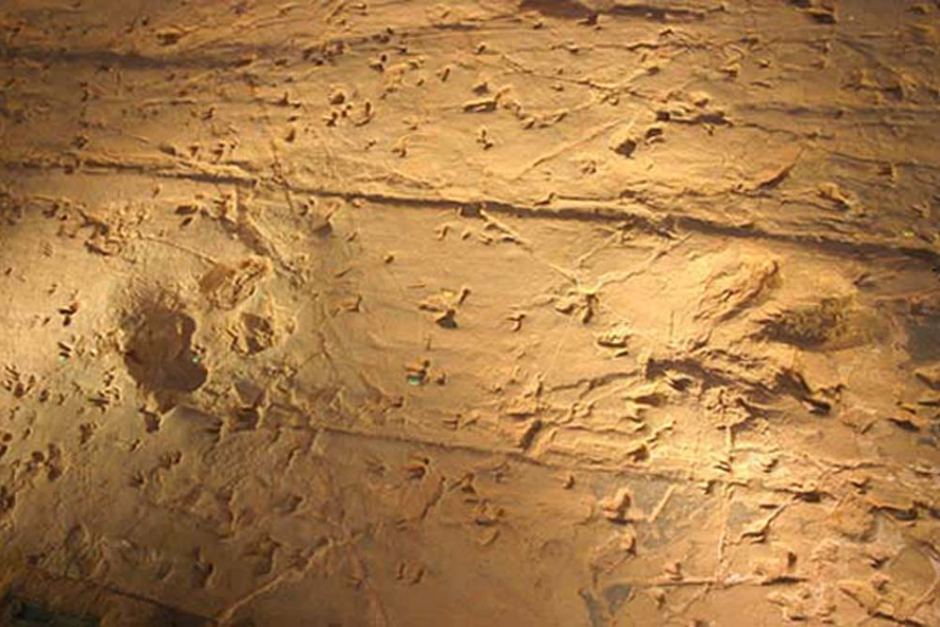
Dickinsonia, one of the Ediacaran fossils in question. Is this a land-dwelling lichen or sea-dwelling invertebrate? (Source: Greg Retallack)
Anna Salleh
ABC
Ancient fossils found in South Australia lived on land,
argues one researcher, whose controversial claim has huge implications
for the tree of life.
Professor Gregory Retallack of the
University of Oregon, reports his findings today in the journal
Nature.
"This discovery has implications for the tree of life, because it
removes Ediacaran fossils from the ancestry of animals," says Retallack,
who is originally from Australia.
The Ediacaran period ended around 540 million years ago, just before
the Cambrian period, which saw a massive explosion in marine animal
life.
Since Ediacaran fossils were first discovered in South Australia they
have been generally regarded as marine invertebrates and an
evolutionary precursor to the Cambrian marine explosion.
But now, Retallack has thrown the cat among the pigeons by suggesting
that the South Australia Ediacaran fossils were not marine at all, but
lived on land.
Retallack, a palaeopedologist, analysed sediments associated with
Ediacaran fossils from the Flinders Ranges and says he has found
evidence of fossil soils.
"They show variation in chemistry, variation in grain size, and
variation in clay minerals that is quite comparable with a modern desert
soil," he says.
Retallack says a number of the Ediacaran fossils, including
Dickinsonia (pictured) show structures similar to today's lichens, and
he also says there is evidence the land they were growing on was
sometimes frozen.
A big claim
If Retallack is correct, it
means that Ediacaran fossils represent an independent branch on the tree
of life, and that life on land during this time may have been more
complex than life in the sea.
Dr Jim Gehling of the South Australian Museum says if Ediacaran
fossils were not the distant soft-bodied ancestors of animal life, then
the Cambrian explosion would have come from "nowhere".
"I'm sorry, I'm not a creationist. I do not believe that the Cambrian
animals popped into existence out of the blue at the beginning of the
Cambrian," he says.
Gehling says Retallack does not have enough good evidence to back his claims.
"It's the right of every scientist to put up controversial hypotheses
but you really have to have good evidence if you want to set up a new
paradigm," he says.
Wave ripples
Gehling says there is no
doubt that the Ediacaran fossils in South Australia are marine because
they are associated with wave ripples and other features only formed in
marine environments.
"99 per cent of the people who have worked on these agree," says Gehling, a palaeontologist and sedimentologist.
He also rejects the evidence of fossil soils, arguing that
Retallack's chemical analysis is picking up contamination from more
recent weathering events of the ancient rock outcrops that the fossils
are found in.
Finally, he says there's no evidence there was ice at that time or that Dickinsonia has the structure of lichens.
Indeed, says Gehling, there is evidence that Dickinsonia was mobile, which supports the idea it was an animal.
Gehling says evidence suggests animals only crawled onto land 100 million years after the Ediacaran.
Soil chemistry
But
Retallack defends his contribution. Among other things he says the
oscillating wave ripples associated with the fossils could have come
from floods or lakes.
And he says the structure of the clays in the sediments he studied is
indicative of soil that has metamorphosed under great pressure.
Retallack says the soil would have originally formed at the surface 500
million years ago before being buried 5 kilometres underground and then
being uplifted again to the surface.
He is not fazed by the problem that his ideas present for the tree of life.
Indeed Retallack says that it's possible that life on land could have helped drive the Cambrian explosion in the sea.
Like modern plants, lichens could have changed the soil chemistry, he
says, allowing the release of mineral ions into the soil water.
"Some of this soil water runs off into streams end eventually the
ocean," says Retallack. "That is going to be the engine that drives the
Cambrian explosion."
"What we're looking at here is the early stages of the ramping up of
that process to create the nutrients needed for animal life in the sea."
In the same issue of
Nature, a forum reports views from two experts with different takes on Retallack's paper.
While geologist Professor Paul Knauth of Arizona State University
says Retallack has a "considered case" that calls for sceptics to learn
more about fossil soils, palaeontologist Professor Shuhai Xiao says his
evidence is "ambiguous" and is outweighed by "compelling evidence" for
the marine origin of Ediacaran fossils.