Pterosaurs flew like jumbo jets

Sunday, January 26, 2014

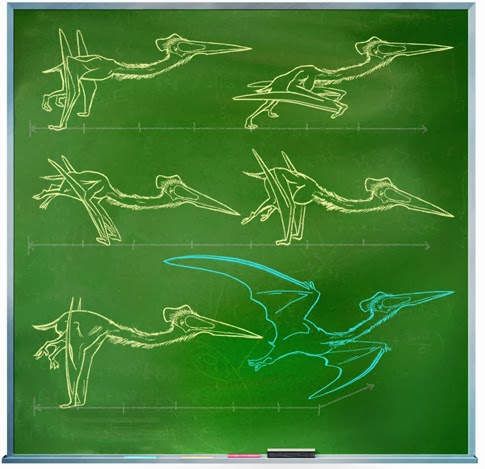
Illustration of the pterosaur quadrupedal launch. Appeared in Popular Science, credited to Kevin Hand (3 March 2009). 

Rossella Lorenzi
Discovery News

Pterosaurs, the flying lizards of the dinosaur age, ruled prehistoric skies with aerodynamic tricks like those found in modern aircraft, according to a fossil study. 

Pterosaurs appear in the fossil record at the end of the Triassic period, 220 million years ago and were the first vertebrates to achieve true flapping flight.

Like their dinosaur cousins, the creatures were affected by the mass extinction at the end of the Cretaceous period 65 million years ago, leaving no descendants.

Pterosaurs had light, hollow bones, but had wingspans up to 9 metres and more.

Indeed, fossilised bones recently found in Mexico suggest these creatures could have had a wingspan of at least 18 metres, the size of a plane.

Scientists have long wondered how these prehistoric jumbo jets could fly.

Now Dr Matthew Wilkinson of the University of Cambridge and colleagues report in the current issue of the journal Proceedings of the Royal Society B: Biological Sciences that these flying reptiles could take off and make soft landings thanks to the animal's pteroid bone.

The pteroid bone's connected to the ...
The pteroid was a long, slender bone unique to pterosaurs, was bent at the wrist and supported a membranous forewing that acted as a large flap at the front of each wing.

Scientists have debated the function of this bone, particularly its position in the wing.

Fossil studies suggest that it pointed toward the body, and that the forewing was relatively narrow.

Other studies suggest it was directed forward during flight, resulting in a much broader forewing.

"It is not possible to resolve the debate about pteroid function using fossil evidence alone," the researchers write.

They tackled the problem a different way. Using wind tunnel tests of scale models of pterosaurs, the researchers compared the performances of each position of the pteroid bone.

"We discovered that lift is greatly increased if the pteroid bone pointed forwards in flight, not inwards as had been previously believed. This had the effect of expanding the skin-like forewing in front of the arm," says Wilkinson.

Just like plane flaps
The high lift would have been vital in allowing the largest pterosaurs to take off and land, in a similar way that flaps work on aircraft wings.

Large pterosaurs would have been able to take off simply by spreading their wings while facing a breeze. The leading edge flap would also have slowed landings, acting as an airbrake.

"It would have also served as a control surface during normal flights. For example, flexing one pteroid while extending the other would have increased lift on one wing, thereby initiating a roll," the researchers write.

According to UK dinosaur expert Darren Naish of the University of Portsmouth, the study "provides a new rigorous interpretation of pterosaur aerodynamics".

"This work solves several mysteries that have long existed, and shows that pterosaurs evolved novel solutions to the problems of active flight."

Dino model shows the glide path to flight


Microraptor was a two-footed dinosaur - theropod - and the first to have feathers on its arms, legs and tail (Source: Jason Brougham/University of Texas, Austin)

ABC/AFP

Scientists using a wind tunnel and a full-scale model have shed light on how feathery dinosaurs adapted to the skies, a new study reports.

A widening consensus among palaeontologists is that birds evolved from small, feathery dinos. But the question is how?

Researchers at the University of Southampton created an anatomically correct model of a five-winged dinosaur deemed to be a precursor of birds.

"Normally people build models without the feathers, but we've tried to include the feathers because they bend with the wind and so we've got a combination of effects going on there," says study co-author Colin Palmer.

Microraptor was a two-footed dinosaur - theropod - and the first to have feathers on its arms, legs and tail, providing it potentially with five surfaces with which to gain "lift" against the air.

"It was a small animal that was discovered 15 years ago in the north east of China, and supposed to have been one of the first to have flown. So understanding how it flew is really important to know how flight began 150 million years ago," says Jacques Van der Kindere who was also involved in the study.

Experiments in a wind tunnel, supported by flight simulations, showed that even though these wings were rudimentary compared to those of modern birds, it could still carry out slow glides from low heights.

"Using a wind tunnel allows us to measure lift - the amount of force it could produce vertically to keep it in the air - the drag - the resistance to motion, and those two together gives us an idea of the speed that the animal could fly at. It also gives us the ability to look at the stability," says Palmer.
From a height of about 30 metres, it could glide between 70 and 100 metres - a useful means of grabbing a prey or fleeing a predator.

Judged by this, microraptor probably climbed a bit, foraged for food on the ground and glided only on occasion, say the authors.

"Microraptor did not require a sophisticated 'modern' wing morphology to undertake effective glides," write the authors of the paper published in the journal Nature Communications.

"Symmetric feathers first evolved in dinosaurs for non-aerodynamic functions, later being adapted to form lifting surfaces."

A leading hypothesis in the origin of birds is that, after learning to glide, feathered dinosaurs underwent evolutionary pressures that led to a more sophisticated wing, able to flap efficiently and adapt its shape to winds.
 

Smaug Breathes Fire Like A Bloated Bombardier Beetle With Flinted Teeth

Sunday, January 5, 2014


January 2, 2014

What does a narcissistic flying reptile that loves the taste of crispy dwarves have in common with a beetle that shoots hot, caustic liquid from its butt? More than you think.

A few weeks ago, audiences were finally treated to the Cumberbatch-infused reptilian villain from J.R.R. Tolkien’s classic The Hobbit. Smaug (pronounced and interpreted as if you smashed together “smug” and “smog”) is a terrible dragon that long ago forced a population of dwarves from under a mountain. He laid claim to all their treasures. He burned all their homes. The titular character of the book is then tasked with helping a company of these displaced dwarves take back the mountain from the beast. It wouldn’t be easy—the most common descriptor of a dragon is “fire-breathing,” after all. But unlike other aspects of the book and now the film that are wholly magic, Smaug’s burning breath is actually one of the least magical, and can be wrangled into plausibility. Doing so involves looking inside a beetle’s butt, a Boy Scout’s satchel, and a bird’s throat.

Even though they don’t exist, dragons, like all other real organisms, have evolved over time. They weren’t always so huge. Dragons were once the size of cattle in popular depictions. And some of them didn’t have wings, or breathe fire. Today’s dragons are uniquely terrible lizards—massive, spiked, voracious, flame-spewing beasts. If even mythical beasts evolve, how would a real dragon evolve its most recognizable ability?

First, a dragon needs fuel.

This aspect of dragon fire is the easiest to imagine. In fact, you are probably producing dragon fuel as you read this sentence. Methane—a highly flammable gas that is produced naturally by bacteria in the gut—is constantly bubbling up in your stomach as microbes munch on your food. With a large stomach or even a separate organ to house this gas, a dragon could easily eat enough food to produce a large amount of methane.

If methane isn’t the fuel, another more exotic liquid might be. Take the bombardier beetle. This incredible insect evolved (yes, evolved) a way to harness the chaos of chemical reactions in a defense mechanism. When under threat, the beetle excretes two chemicals from two separate reservoirs that mix in a third, producing a very hot liquid and the gas needed to propel it into the face of some would-be predator.

When two liquids come together, react, and spontaneously combust, they are called “hypergolic.” The bombardier beetle isn’t the only organism that takes advantage of hypergolic chemicals; we use them in rocket fuel. (You can see a nice small-scale demonstration of a hypergolic reaction here.) A dragon could do the same. It wouldn’t be the first fiction animal to do so either. Who can forget (or maybe remember?) the giant, fire-spewing “tanker” bug from the ironically classic sci-fi movie Starship Troopers?

If a dragon convergently evolved chemicals that combust upon mixing, like the explosive bombardier beetle, the reaction it harnessed could result in fire…terrible, terrible, fire. But these chemicals aren’t cheap, biologically speaking. A dragon would have to make a large biological investment to produce them. That would at least be consistent with dragons’ voracious appetite for dwarves, men, and livestock—the winged beasts need to produce more rocket fuel.

The next step in fire breathing is the spark.

Before you see a dragon’s flame you see the teeth. Terrifying spears and stake knives that click and clamor inside gigantic mouths—giant flints. Some dragon lore speculates that dragons, like modern birds, ingested rocks and stones to aid in digestion. Over time, stories say, the minerals would coat dragon teeth. Or maybe the dragons could hold some minerals in their mouths. Either way, quickly biting down on these minerals could produce a spark. Like a Boy Scout’s trusty flint, clicking dragon teeth would provide the ignition for either a glut of methane gas or a gush of hypergolic liquids (if needed).

Another possible spark could come from more detailed physics. If dragon teeth had piezoelectric properties—where mechanical stress produces small jolts of electricity—a combination of methane exhalation and teeth grinding could light the fire. Or maybe the crushed stones and minerals could vaporize in the air ahead of the methane and combust, as metals do on helicopter rotors in the Kopp-Etchells Effect. Perhaps the dragons could expel the liquids or gases so quickly from their bellies that static ignition would occur. (When cleaning out supertankers, for example, all the flammable vapors first must be vented. The high-pressure water jets used in cleaning can generate sparks that ignite the gas.) Could a dragon evolve an organ that produces its own spark like a kaiju from Pacific Rim? Science has many sources of ignition to choose from, it’s just a matter of what the fiction allows.

Dragons are basically our pipe-dreams of what birds would be if they still looked liked ancient dinosaurs but followed evolution’s flight plan. Dragons’ similarities with birds (themselves in fact dinosaurs) could provide the last critical link to flame flinging. With multiple stomachs aiding digestion, birds—and by extension, dragons—could evolve a specialized sack for storing either methane or combustible chemicals. Birds also eat stones and rocks to break up tough material in these stomachs, so Smaug munching on minerals isn’t that far-fetched either.

There are still a few problems. Dragons are huge, undoubtedly heavy creatures that would likely rip their own wings to shreds when attempting to stay airborne. Also, holding both a large amount of methane or hypergolic chemical internally is explosively problematic. Breathing out fire is a problem in and of itself. A dragon would need specialized tissues in the mouth to deal with the incredible heat, and lungs large enough to force the flames a significant distance (unless it was a dragon from Skyrim, which specializes in powerful blasts of voice). I imagine that a more scientifically plausible dragon wouldn’t be the slender, monitor lizard-like monstrosity we see in the latest Hobbit film and more like a flightless, bloated flame-thrower.

What does this mean for The Hobbit, a universe already filled with magic? Nothing at all. The film has its own problems to deal with. Nonetheless, I found Smaug’s fire breath to be one of the least distressing suspensions of reality. Whether a “true” fire-breathing dragon is filled with flint, gas, or rocket fuel, one thing is for sure: Where there is Smaug, there is fire.

About the Author: Kyle Hill is a freelance science writer and communicator who specializes in finding the secret science in your favorite fandom. Follow on Twitter @Sci_Phile. 

Gentle dino giant had fleshy cock's comb

Monday, December 30, 2013

The discovery of a comb atop Edmontosaurus is a first (Source: Artwork by Julius Csotonyi/Bell, Fanti, Currie, Arbour, Current Biology)

Anna Salleh
ABC

A duck-billed dinosaur from North America had a fleshy cock's comb that it probably used to communicate with others of its species, say researchers.

The comb, found in a rare mummified specimen of Edmontosaurus regalis, is reported today in Current Biology.

"The discovery of the comb was a total surprise because there is no indication from any other dinosaur that these animals had such a structure," says palaeontologist and lead author Dr Phil Bell of the University of New England.

At 10-12 metres long and weighing up to 4 tonnes, Edmontosaurus regalis was one of the most common dinosaurs to live 70 million years ago.

"It was a big gentle herbivore," says Bell. "It would have filled the same ecological role as a kangaroo would, or a deer."

He says the animal's skull is long and low like a horse's skull, and the front end of its jaws have no teeth and is broad like a duck bill.

Scientists have known about Edmontosaurus for a century, and there are numerous complete skeletons, some even with skin, but the latest discovery was never expected, says Bell.

He says co-author Frederico Fanti discovered the new specimen while the two of them were prospecting in a river in Northern Alberta.

Back in the lab, Bell started to chip away at the surrounding earth and that's when he struck gold.

"I'd uncovered the skin on parts of the neck and I could see where the head was going, so I put my chisel in the rock where there shouldn't have been skin, and low and behold, there was," he says.

"It was a mistake but a lucky blow, in the end."

Bell says the findings suggested a three-dimensional cranial crest, or comb, made of soft tissue.

"There was a fleshy substance and wrinkles on the preserved skin so we know it was supple. It was probably a fatty tissue underneath," he says.

Communication device


Bell says some relatives of the dinosaur have been found to have a bony crest, which are extensions of the nasal passages and were used as resonators when the animals called out to each other.

He says the bony crests disappeared at the end of the Cretaceous when Edmontosaurus appeared.

Its fleshy crest was in the same place as the previous bony crests but had no connections to the nasal passage.

Bell says it's likely that Edmontosaurus, which travelled in herds for protection, used the crest to communicate.

"There's always some kind of hierarchy in a herd," he says. "We believe this crest was used to signal to mates or to confer its position within the herd hierarchy - 'he with the biggest crest wins' kind of thing."

Bell says this is supported by the fact that modern-day birds - from the rooster to the Andean condor - all have brightly coloured crests that are used to signal to each other.

It's all in the skin


While most scientists are interested in skeletons, Bell has devoted his career to looking at skin on dinosaurs.

"It's the skin and the flesh that really give you that true life picture," he says.

The preservation of soft tissues like this is made possible by a special "mummification" process that was common in the area he and colleagues were exploring, says Bell.

"Animals were dying but getting buried very rapidly, probably within a space of a couple of days after they died," he says.

And, says Bell, the sediment that "entombed" the dinosaurs was anaerobic and probably contained bacteria that precipitated out certain elements like manganese, iron and calcium from the water to help preserve the skin.

Bell says it is interesting the comb was found in a herbivore like Edmontosaurus which is not closely related to birds.

But, he says, there may well be combs on therapods that have yet to be discovered.

"This opens the possibility that we have all kinds of soft tissue structures that we've never seen," he says. "We're in for more surprises, I think."

Basilosauridae

Wednesday, December 18, 2013


Basilosauridae, the so-called zeuglodonts, referring to their complex, many-cusped teeth (the Greek zugotos means yoked or joined, and odous, of course, tooth). The most primitive archaeocete identified to date was Nalacetus, known mainly from isolated teeth. Pakicetus, another small, very early archaeocete, had eyes on top of its head, drank only fresh water (confirmed from oxygen isotope ratios in its tooth enamel), and was predominantly wolf- or hyena-like in appearance. The other families of archaeocetes had been largely supplanted by the zeuglodonts during the late Eocene. Probably the best-known zeuglodont was Basilosaurus, or the "king lizard" (from the Greek basileus for king and sauros for lizard). This animal could be almost 70 ft (21 m) long and weighed at least 11,000 lb (5,000 kg). Its small head in relation to the long body made it appear truly serpentine. The front appendages had been modified into short, broad paddles, but were still hinged at the elbow; and the rear appendages had atrophied to nothing more than stumps. 

Basilosaurids may have had dorsal fins and horizontal tail flukes, and they were likely hairless, or nearly so. In short, Basilosaurus was well along the path to becoming what cetologists now think of as a whale. The archaeocetes are replaced in the fossil record by odontocetes and mysticetes beginning in the Oligocene, about 38 mya. By approximately the middle of that epoch, the archaeocetes appear to have died out completely. The oldest known cetacean in the mysticete clade is Llanocetus denticrenatus, found in late Eocene rocks on the Antarctic Peninsula. 

This species' most characteristic feature was its series of lobed, widely spaced teeth, which were somewhat reminiscent of the teeth of the crabeater seal (Lobodon carcinophagus). Like the crabeater seal, L. denticrenatus was probably a filter feeder on krill-like invertebrates or possibly small schooling fish. At least four families of tooth-bearing mysticetes have been described from the Oligocene (24-38 mya). The transition leading to rudimentary baleen plates in the spaces between teeth probably occurred about 30 mya with the emergence of the Cetotheriidae, or primitive baleen-bearing mysticetes. It is a slight misconception to say that the presence of teeth is a diagnostic feature of Odontoceti, the so-called toothed whales, because all archaeocetes and some of the primitive fossil mysticetes also had teeth. Further, all of the modern baleenbearing mysticetes have teeth in the early fetal stages of their development. 

Odontocetes also radiated rapidly and widely during the Oligocene, by the end of which there were more than 13 families and 50 species of cetaceans in the world's oceans. This diversity was probably driven by changes in foraging opportunities related to breakup of the southern supercontinent of Gondwana, opening of the Southern Ocean, and the consequent polar cooling and sharpening of latitudinal temperature gradients. Several of the early odontocete lineages failed to survive beyond the Miocene (5-23 mya). The shark-toothed dolphins (Squalodontidae), with their sharp, triangular, serrated teeth, were likely active carnivores, while the very longbeaked Eurhinodelphinidae, with their overhanging upper jaws and many small, conical teeth, were more like the dolphins that cetologists know today. Both of these groups had vanished from the fossil record, and others had dwindled to mere remnants, by the end of the Miocene. 

The cetotheres radiated further during the Miocene (5-23 mya), with more than 20 genera in which the blowholes were positioned about as far back on the top of the head as they are in living mysticetes. Also, by the early Miocene, the two main branches of cetotheres were evident, one leading to the modern right whales (Balaenidae) and the other to the rorquals (Balaenopteridae) and gray whale (Eschrichtiidae). Gray whales do not appear in the fossil record until only about 100,000 years ago, and their ancestry is therefore particularly problematic. For their part, the odontocetes also experienced a major Miocene radiation. Beaked whale (Ziphiidae) fossils are common in marine sediments worldwide by 5-10 mya, and these include animals belonging to the modern genus Mesoplodon. Sperm whales in the family Physeteridae, similar in some important ways to the living species, were present by 22 mya.

Desolation of Smaug

Tuesday, December 17, 2013


In the film Smaug looks realistic, glows with inner fire when he's about to unleash his deadly breath and has a face so evil looking he's actually a little scary. The HOBBIT: THE DESOLATION OF SMAUG - is Smaug the greatest cg character since Gollum?

In the sixth and final War of Wrath in Beleriand, winged dragons first appear, the mightiest of which is Ancalagon the Black. At the climax of this war, Ancalagon is slain by Eärendil in a titanic battle ending with the dragon's cataclysmic fall upon the towers of Morgoth's realm. In the victory over their Enemy, the Valar destroy ``well-nigh all the dragons''; an earlier version of the ``Quenta Silmarillion'' published in The Shaping of Middle-earth says two escaped into the East. These were apparently male and female, for they are said to have bred in the dark places of the earth to afflict the world, ``as they do still.'' The Lord of the Rings' Appendix A mentions their multiplying and growing strong in the wastes of Ered Mithrin north of Mirkwood- yet another class of dragons called colddrakes, apparently lacking fire-which slay King Dain I and Fro' r his son and drive the Dwarves out. About two hundred years later, Smaug-the fiery dragon of The Hobbit-descends on the Lonely Mountain. 

The Hobbit has been seen as a dragon-slayer narrative of the Beowulf type rewritten as a comic children's story (Stein). Bilbo's adventures climax with the slaying of Smaug by Bard, a Man from Laketown, by an arrow-shot to a small unarmored spot on the dragon's underbelly-a motif borrowed from Germanic sources. A speaking dragon like Glaurung, Smaug is modeled on Fäfnir, whose dying speech prophesies Sigurd's doom. Despite its comic tone, Smaug's voice has the unsettling effect of malevolent threat masked in jocularity. Smaug and other dragons are presented as extremely old, a characteristic mentioned in Beowulf and probably based ultimately on the biblical dragon of the Apocalypse, the draconem serpentem antiquum qui est diabolus, ``the dragon, that old serpent, which is the Devil'' (Rev. 20:2). The narrator of The Silmarillion says ``long and slow is the life of the dragons.'' Also mentioned in The Hobbit are the ``Wild Were-worms of the Last Desert'' (H, I, 49) otherwise unexplained but seemingly a reference to the human-to-dragon transformation motif of Germanic tradition (cf. werewulf, ``man-wolf ''). 

Dragons as such do not appear in The Lord of the Rings. In the Shire, Ted Sandyman scoffs at them as relics of children's stories; Gandalf comments that dragon-fire could melt the Rings of Power, but no dragons left on earth are hot enough and not even Ancalagon the Black could have melted the One Ring. At the end of the book, Merry Brandybuck is awarded a Dwarf-made horn taken from the hoard of Scatha the Worm by Fram-a Man of Rohan, slayer of the dragon.