Croc extinction led to dinosaur domination

Thursday, April 4, 2013


Pseudosuchians such as Longosuchus meani had features like sturdy body armour and strong tails for whacking enemies (Source: Nobu Tamura/Wikimedia Commons)

Jennifer Viegas
Discovery News

A mass extinction that occurred over 200 million years ago, killed off a slew of huge predators, including hefty beasts that looked like crocodiles and enormous armadillos, according to new research.

Some of the prehistoric predators - animals known collectively as the early pseudosuchians - likely preyed on certain dinosaurs, which later evolved some of impressive characteristics of the ancient pseudosuchians. Those included features like sturdy body armour and strong tails for whacking enemies.

"It is likely, therefore, that dinosaurs prospered to some extent as a result of the extinction of most pseudosuchians and many other groups at the end of the Triassic," says co-author Richard Butler, a palaeontologist at Ludwig-Maximilians-Universität.

He adds that some evidence suggests dinosaurs "had better locomotor and breathing systems than pseudosuchians," so they thrived in the Jurassic after the mass extinction.

As for what caused that die-off, researchers suspect an enormous burst of volcanic activity, as part of the Atlantic Ocean's formation, led to dramatic increases in atmospheric carbon dioxide and rapid global warming.

For the latest study, published in Biology Letters , Butler and colleague Olja Toljagić assessed changes in pseudosuchians that occurred during the critical Late Triassic and Early Jurassic periods.
The study shows that during the extinction event 201 million years ago, these animals declined rapidly, with only one lineage surviving into the Jurassic. Some of the animals evolved into ancestors of today's alligators and crocodiles. Another lineage, referred to as the "bird-line archosaurs", consisted of the non-avian dinosaurs and their species that later evolved into modern birds.

Luck, in part, helps to explain why some animals died, while others survived.

"Selectivity of mass extinction events is sometimes linked with body size, ecological constraints and competition, while other times it could be related to just pure luck of the survivors," explains Toljagić.

Rise of new archosaurs

Stephen Brusatte, a palaeontologist at the University of Edinburgh, previously studied how crocodile-line archosaurs changed during the Triassic and across the Triassic-Jurassic boundary.

Brusatte says that the recent study by Butler and Toljagić is important "because we really need to understand what happens at mass extinction events in order to better understand how our own world may change in the face of warming temperatures."

"Many early relatives of crocodiles flourished during the Triassic, but many of them were killed off at or near the Triassic," he says."After they were killed, whole different groups of crocodile-line archosaurs had a chance to rise in their place, and it was this dramatic moment that was the root of the diversification of the lineages leading to living crocodiles."

More than anything, he says, this study shows what can happen during and after mass extinction events.

"Extinctions often reset the evolutionary clock," he concludes.

Non-avian dinosaurs appear to have benefited, at least in part, from one extinction event, but they bit the dust during another. Mammals then seem to have benefited when the dinosaurs died out.

It remains to be seen which mammals - including humans - will survive the next big extinction event. The current biodiversity crisis has already resulted in drastic population drops for some species and the extinction of others.


Arthropleura

Sunday, January 27, 2013


Arthropleura was an ancestor to centipedes and millipedes. It could reach more than eight feet (2.4 m) in length, and the fatter creatures could be several feet wide—think, for a moment, of something like that brushing up against your leg. It was so massive that despite being an invertebrate it probably had very few predators, and it is by far the largest invertebrate species ever unearthed.

Arthropleura lived from the Carboniferous to the early Permian period—throughout what is now North America and Scotland—around 300 million years ago. Strangely, even though its monstrous form would have allowed it to prey on most anything, Arthropleura was entirely herbivorous (as shown by the fossilized remnants of its stomach). It wouldn’t have taken any magic to resize this bug for James’ giant peach.


Nothosaurus


Nothosaurus (meaning false reptile) is an extinct genus of sauropterygian reptile from the Triassic period, approximately 240-210 million years ago, with fossils being distributed from North Africa and Europe to China. It is the best known member of the nothosaur order.


Nothosaurus was a semi-oceanic animal which probably had a lifestyle similar to that of today's seals. It was about 4 metres (13 ft), with long, webbed toes and possibly a fin on its tail. When swimming, Nothosaurus would use its tail, legs, and webbed feet to propel and steer it through the water. The skull was broad and flat,with long jaws, lined with needle teeth, it probably caught fish and other marine creatures. Nothosaurus hunted by sneaking up slowly on prey, such as shoals of small fish, then putting on a last-minute burst of speed. Once caught, few animals would be able to shake themselves free from the mouth of Nothosaurus.


In many respects its body structure resembled that of the much later plesiosaurs, but it was not as well adapted to an aquatic environment. It is thought that one branch of the nothosaurs may have evolved into plesiosaurs such as Liopleurodon, a short-necked plesiosaur that grew up to 6.4 metres (21 ft), and the long-necked Cryptoclidus, a fish eater with a neck as long as 9 metres (30 ft).


LINK

Tanystropheus


While Tanystropheus was not strictly marine, its diet was mainly fish and scientists think it spent most of its time in the water. Tanystropheus was a reptile that could reach 20 feet (6m) long, and it is thought to have been alive during the Triassic period nearly 215 million years ago.

Tanystropheus longobardicus, a diapsid reptile from the Middle Triassic, 230 million years ago. Young specimens have relatively short necks, which apparently grew quickly as the animal reached adulthood. Its long neck was more than twice the length of its body and tail, and it apparently attained a total length of 10 feet. Found in marine sediments in Central Europe, Tanystropheus may have been a coastal swimmer that fed on fishes. In the 1970s, Hall discovered a 12-inch reptile with a forked tongue in a marshy area bordering Lake Champlain. It was sent to the University of Vermont, where it was subsequently lost. He later ran across a drawing of Tanystropheus and thought it was very similar. A smaller relative from the Late Triassic, Tanytrachelos, has been found in Virginia.


LINK

Fossil find could be oldest dino of all

Monday, January 14, 2013


A reconstruction Nyasasaurus from the Middle Triassic of Tanzania(Source: Mark Witton /Natural History Museum, London)

Fossilised bones unearthed by a British palaeontologist in colonial Tanzania in the 1930s may be those of the oldest dinosaur ever found, say researchers.

The bones are either of the earliest dinosaur or of the closest relative of dinosaurs discovered to date, they report in the journal Biology Letters.

A denizen of the Middle Triassic around 243 million years ago, the creature predates all previous dinosaur finds by 10 to 15 million years, the scientists say.

The specimen also points to the possible birthplace of these enigmatic species in a mega-continent called Pangaea, they add.

Dubbed Nyasasaurus, the putative dino was about 80 centimetres high, up to three metres in length and had a tail up to 1.5 metres long, according to their study.

It probably weighed between 20 and 60 kilograms.

"If the newly-named Nyasasaurus parringtoni is not the earliest dinosaur, then it is the closest relative found so far," says Sterling Nesbitt of the University of Washington.

Nyasasaurus' name derives from Lake Nyasa - now called Lake Malawi - and from a University of Cambridge palaeontologist, Rex Parrington.

His team excavated the six vertebrae and upper arm bone from sediment in the Ruhuhu Valley of southern Tanzania in the early 1930s.

That location, say the authors, backs theories that dinosaurs evolved in the southern portion of the supercontinent of Pangaea, where Earth's land masses were glommed together before the pieces drifted apart to form continents.

The southern part of Pangaea comprised Africa, Australia, South America and Antarctica.
For decades, the Nyasasaurus bones languished and were never formally documented.

Their true importance has only been made clear today, thanks in part to modern scanning technology which compared Parrington's specimens in London's Natural History Museum against two other Nyasasaurus bones at the South African Museum in Cape Town.

What makes the finds special is that they share many important features of dinosaur bones as well as imprinted traces of tissue showing that the creature grew rapidly, again a dino characteristic.

"For 150 years, people have been suggesting that there should be Middle Triassic dinosaurs, but all the evidence is ambiguous," says Nesbitt.

"Some scientists used fossilised footprints, but we now know that other animals from that time have a very similar foot.

"Other scientists pointed to a single dinosaur-like characteristic in a single bone, but that can be misleading because some characteristics evolved in a number of reptile groups and are not a result of shared ancestry."

The Triassic Period - between 252 and 201 million years ago - not only presided over the rise of the dinosaurs. It also saw the emergence of turtles, frogs, lizards and mammals.

If the new study is right, the reign of the dinosaurs was even more successful than thought.
The "giant lizards" spanned some 178 million years until their lineage was blotted out by an extinction event, presumed to be a giant space rock that whacked into the planet.

 AFP

Stampede site 'may be dinosaur river crossing'

Thursday, January 10, 2013


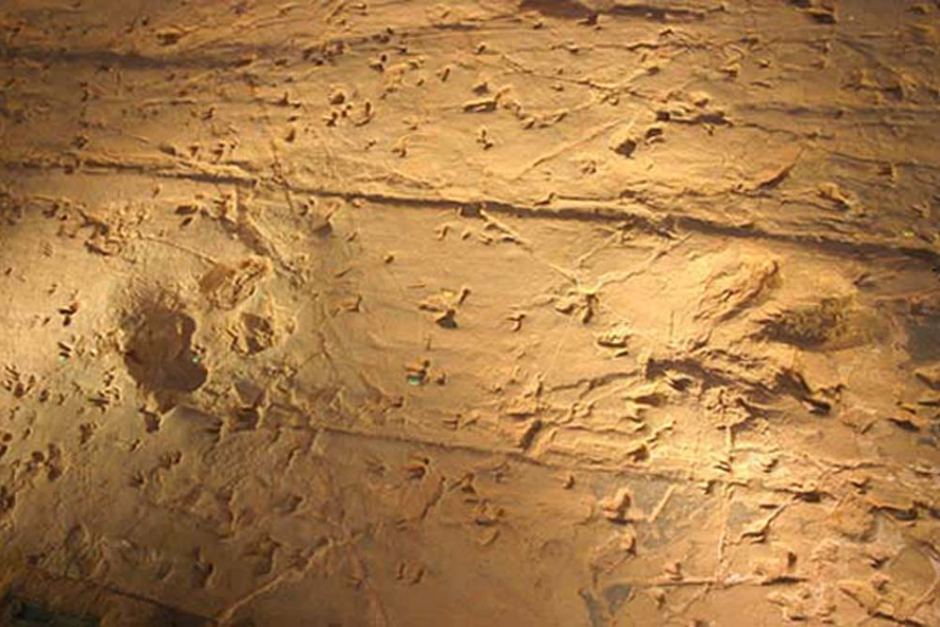
Some of the fossilised dinosaur footprints at Lark Quarry in central Queensland.

New research at a site in central-west Queensland suggests the area is not the world's only recorded dinosaur stampede - but a river crossing.

The Lark Quarry Conservation Park at Winton had been believed to be the site of a dinosaur stampede from about 95 million years ago.

But after a two-year study, University of Queensland PhD candidate Anthony Romilio says thousands of footprints at the site were not made all together, but over a period of a few days or weeks.

He believes the site is the bed of an ancient river which dinosaurs were able to wade across, leaving footprints in the soft mud.

"The dinosaurs seemed to be using this area as a highway in fact, and it didn't matter that it was covered in water," he said.

"Even very small dinosaurs ... the size of, say, chickens, were swimming, using the river current to assist their movements.

"The water there wasn't preventing them from going places."

Winton Mayor Butch Lenton says he hopes the new discovery will not affect tourism to the popular site.

He believes the river crossing claim will actually make the destination more interesting.

"There's tracks down there and there's always been views on how they were made," he said.

"But it will be interesting because the different points of view [about] how those tracks got there and how they happened, so it's all interesting."

Mr Romilio agrees his research does not make the western Queensland site any less significant.


He says it is a new interpretation of a track site that was excavated 30 years ago.

"It's quite an amazing site because you have thousands of dinosaur footprints, all or most of them heading in the one direction," he said.

"I guess the analogy is when you go walking on the beach and you see so many footprints of people on the beach, you think, 'Hey, did this occur all at one time ... or at different times?'"


Morgoth’s Drakes


Ancalagon the Black.

Among Morgoth's most deadly creations were the Great Worms called Dragons. These majestic beasts existed as three kinds: those that slithered, those that walked, and those that flew. Of each kind there were two types: Cold-drakes, the most common, who fought with great strength of fang and claw, and the Fire-drakes (Urulóki), who blasted foes with breath of green and scarlet flame. Though gifted with intelligence, they had flaws of gluttony, vanity, wrath and sometimes cowardice. Their blood was black and poisonous and they often exuded an overpowering stench of sulphur and slime. All were protected by scales that hardened as they aged. An adult dragon’s scales were nearly impenetrable, though all suffered from a weakness of the scales of the underbelly.

Considered the Father of Dragons, Glaurung the Fire-drake was the greatest terror of his time, though he was not as powerful as the later winged race of dragons. In his youth he issued from Angband’s gates at night and defiled the fields of Ard-galen. Because Glaurung’s scales were not grown to full strength he wasn’t able to resist the arrows of the elven cavalry of Prince Fingon, and was driven back. He did not appear again for well-nigh two hundred years. When he did it was at the forefront of Morgoth’s Host at the onset of the Dagor Bragollach (Battle of Sudden Flame). Glaurung assisted in the scouring of Ard-galen (which thereafter became known as Anfauglith, the Gasping Dust), the destruction of Dorthonion, and the lifting of the Siege of Angband. Glaurung led the sack of Nargothrond, cast his spell on Turin Turambar and Nienor, and was eventually slain by Turin at Cabed-en-Aras.

The mightiest Dragon that ever lived was named Ancalagon the Black, the first of the winged Fire-drakes. He and others like him stormed out of Angband as a last line of defense of Morgoth's realm during the War of Wrath that ended the First Age. He was slain in battle by Earendil, and destroyed the towers of Thangorodrim when he fell. The rest of the winged drakes were slain or fled and the histories of Middle-earth speak little more of them until the Third Age of the Sun.

The last of the great firedrakes. In the twenty-eighth century of the Third Age, the greatest Dragon of that time came from the North guided by rumor of the hoarded wealth of the Dwarven kingdom under Mount Erebor. This was the famous winged Fire-drake called Smaug the Golden. Smaug laid waste the Dwarf-kingdom and for two centuries guarded the hoarded wealth unchallenged. Yet, in the year 2941, a company of twelve Dwarves and the Hobbit-burglar Bilbo Baggins aroused the great Worm. The wrath of Smaug mistakenly led him to Lake Town (Esgaroth on the Long Lake), where he was slain by Bard the Bowman who hit his weak spot with the Black Arrow. But not before Smaug set the town ablaze.