Meet T.rex's 'bizarre' vegetarian cousin

Tuesday, April 28, 2015

Chilesaurus diegosuarezi represents a new type of theropod (Gabriel Lio)

Tyrannosaurus rex had an odd-looking vegetarian cousin with a tiny head, long neck and stubby fingers, say scientists.
 
Chilesaurus diegosuarezi had a bird-like beak with leaf-shaped teeth, evidence that it feasted on plants, but with hind leg features similar to theropod dinosaurs, the group into which it was slotted with notorious killers like T. rex, Velociraptor and the horned Carnotaurus.

The dinosaur -- nicknamed 'The Platypus -- is described today in the journal Nature .

"Chilesaurus constitutes one of the most bizarre dinosaurs ever found," says study co-author Fernando Novas of Argentina's Natural History Museum in Buenos Aires.

"At the beginning, I was convinced that we had collected three different dinosaurs, but when the most complete skeleton was prepared, it (became) evident that all the elements pertained to a single dinosaur species."

The bizarre dinosaur was named after the South American country where its fossilised remains were found, and the seven-year old boy, Diego Suarez, who discovered the first bones in 2004 while exploring the Andes mountains with his geologist parents.

About a dozen Chilesaurus specimens have since been dug up.

Theropods like T. rex tended to have relatively short necks, big heads and strong, muscled hind legs much bigger than their arms, vicious claws and jaws brimming with razor-sharp teeth.

But Chilesaurus cuts an altogether less threatening figure.

'Jigsaw puzzle' dinosaur

"The proportionally small skull of Chilesaurus, with the presence of a horn beak at the tip of the snout and... leaf-shaped teeth, reveal that Chilesaurus was a strict plant eater," says Novas.
"Its forearms were robust, but the hands were provided with just two blunt fingers."

Most skeletons discovered so far were the size of a turkey, but isolated bones have revealed that Chilesaurus could grow to about three metres in length.

Novas and his team have taken to comparing Chilesaurus to a platypus, which with its duck-like bill, beaver-like tail and otter-like feet.

"We are puzzled by the weird anatomy of Chilesaurus, which recalls different dinosaurian groups," says Novas.

Its pelvis is reminiscent of ornithischian dinosaurs with beaks, like Stegosaurus, and its wide, four-toed hind feet are similar to those of the massive, 'lizard-footed' sauropods like Brontosaurus.

Yet the research team believe Chilesaurus represents a new type of theropod -- "an evolutionary jigsaw puzzle that will generate debate among palaeontologists," says Novas.

Until now, herbivorous theropods were known only in close dinosaur relatives of modern-day birds, but the discovery of Chilesaurus shows that a meat-free diet was acquired much earlier than thought, say the scientists.

Chilesaurus lived at the end of the Jurassic period, some 145 million years ago -- long before T.rex which ruled the plate at the end of the Cretaceous era some 70-65 million years ago.

Related: Stegosaurus plate shape may reveal gender
Related: Brontosaurus thunders back after a century in exile

Tyrannosaurs were violent cannibals

Friday, April 10, 2015

Artists reconstruction of one Daspletosaurus feeding on another. (Tuomas Koivurinne )

Remains of a mutilated dinosaur victim provide strong evidence for what has long been suspected - Tyrannosaurus rex and his kin were violent animals that also practiced cannibalism.
 
The remains, described in the latest issue of the journal PeerJ, are of the large carnivorous tyrannosaur Daspletosaurus, which suffered numerous injuries during its lifetime and was partially eaten after it died.

Palaeontologists believe that members of Daspletosaurus' own species inflicted all of the damage.

"This animal clearly had a tough life suffering numerous injuries across the head including some that must have been quite nasty," says lead author David Hone from Queen Mary University of London.

"The most likely candidate to have done this is another member of the same species, suggesting some serious fights between these animals during their lives," he adds.

Daspletosaurus lived around 77 million years ago in North America. The victim studied by the researchers hailed from what is now Alberta, Canada. It was an older teenager when it bit the dust, so it hadn't grown to full size yet. Still, this was a large animal. At death it measured about 6 metres long and weighed approximately 500 kilograms.

Analysis of this dinosaur's skull uncovered numerous injuries that had previously healed.

Although not all of the injuries can be attributed to bites, several are close in shape to the teeth of tyrannosaurs, Hone says. One bite to the back of the head had broken off part of the skull and left a circular tooth-shaped puncture though the bone.

According to the researchers, the fact that alterations to the bone's surface indicate healing means that the injuries were not fatal and the animal lived for some time after they were inflicted.

The poor dinosaur's life took a turn for the worse later, though. The preservation of the skull and other bones, as well as damage to the jaw bones show that the dinosaur died young and began to decay.

Shortly thereafter, a large tyrannosaur — probably from the same species — chomped into the dead teen dinosaur and presumably ate at least part of it.

The remains are unique in that they provide evidence for both combat between dinosaurs of the same species and cannibalism.

T. rex was closely related to Daspletosaurus. They essentially were cousins and grew to nearly the same sizes as adults. It's therefore likely that T. rex and other large carnivorous tyrannosaurs engaged in similar behaviour.

This article originally appeared on DiscoveryNews.com

Brontosaurus thunders back after a century in exile

Tuesday, April 7, 2015

Brontosaurus (foreground) and Diplodocus depicted by Charles R Knight in 1897 (Wikimedia commons)

Bianca Nogrady
ABC


More than 100 years after it was banished from existence, Brontosaurus can be reinstated as a dinosaur genus, according to a detailed study of the iconic dinosaur's family tree.
 
Palaeontologists from the UK and Portugal conducted a comprehensive anatomical survey of 81 specimens of the Diplodocidae superfamily of large long-necked dinosaurs, which includes Diplodocus, Apatosaurus, and once again, Brontosaurus.

Published today in the journal PeerJ , the researchers argue that their analysis overturns a century-old decision to classify the dinosaur as an Apatosaurus rather than a genus of its own.

'Brontosaurus' is not only one of the most charismatic dinosaurs, but one of the most controversial.
The headless skeletons of two large long-necked dinosaurs were discovered in 1870 and described by US palaeontologist Othniel Charles Marsh. The first was named Apatosaurus ajax -- the deceptive lizard, the second was named Brontosaurus excelsus -- the thunder lizard.

Marsh wrongly reconstructed the skeleton of Brontosaurus excelsus using the head of another long-necked dinosaur, Camarasaurus.

Shortly after Marsh died, palaeontologists discovered another skeleton that was similar to both Apatosaurus ajax and Brontosaurus excelsus. They decided that Brontosaurus was not anatomically distinct enough from Apatosaurus to warrant its own genus, so it became Apatosaurus excelsus.

"What palaeontologists of the time had done was they'd compared the anatomy of the bones and made a subjective decision that these things were relatively similar and might as well be the same," says co-author Associate Professor Roger Benson, a palaeontologist at the University of Oxford.

"In 1903 that decision was made, but Brontosaurus is incredibly iconic and somehow it refused to die in the public imagination, even though scientists thought that it was not a distinct thing."

The final blow to Brontosaurus happened in the 1970s, when researchers showed that Apatosaurus was not closely related to Camarasaurus, but to yet another dinosaur from the same area: Diplodocus.
Recently many more specimens have been discovered, allowing for a more comprehensive comparison across specimens by Benson and colleagues, who have reconstructed the entire branch of the Diplodcidae family tree.

"If we've got lots of specimens and we've got detailed quantitative info about their anatomy, then for every comparison between two specimens, we can come up with a number that's the difference between them," Benson says.

Lead author Dr Emmanuel Tschopp says there were a number of anatomical features that distinguished Brontosaurus from Apatosaurus.

"Even though both are very massive and robust animals, Apatosaurus has a more wide neck than Brontosaurus has, so I think that's the most visual and obvious thing to distinguish the two," says Tschopp, a post-doctoral research at the University of Nova Lisbon.


Family tree

While the return of Brontosaurus will no doubt capture the public imagination, the greater worth of the study is its detailed redrawing of the Diplodocidae family tree, says palaeontologist Dr Steven Salisbury of the University of Queensland.

"People might wonder why that hasn't happened until now, but sauropods [large, four-legged plant-eating dinosaurs] are notoriously difficult to work on because they're so big and awkward to look at," says Salisbury, who was not involved in the research.

Adding to the confusion, many of the sauropod specimens were discovered in the late 19th century, and some were incorrectly reconstructed and mounted, Salisbury says.

There was also an initial rush to name specimens during this period known as the 'Bone Wars', some of which were later challenged as more bones were discovered.

"It highlights how science and particularly taxonomy works," Salisbury says.

"Names are proposed for specimens -- and those names may come and go depending on what people think of a species or genus or a taxon -- but importantly, if you've got specimens to look at all the time you can test those ideas, so names are really just tests of ideas relating to taxonomy."

In addition to reinstating Brontosaurus, the team also discovered a new genus, which they called Galeamopus, that had previously been considered to be just another species of Diplodocus.

At the same time, they concluded that another genus -- Dinheirosaurus -- was not distinct enough from the Suprasaurus genus to warrant its own and was therefore subsumed back into Suprasaurus as a species only.

Glaurung

Sunday, April 5, 2015

Glaurung fighting with dwarves by Justin Gerard

Glaurung by Markus Erdt

Glaurung was the first terrestrial, fire-breathing Dragon in Middle-earth. First of the Fire-drakes was Glaurung, the Father of Dragons. 

After only a century of brooding and growing in the dark pits of Angband, Glaurung first emerged in FA 260 in a fiery wrath, burst from the gates and startled the races of Middle-earth. Though Glaurung was not of the winged race that would later arise, he was the greatest terror of his time. He burned and ravaged Ard-galen, the land of the Elves in Hithlum and Dorthonion. However, he was not yet at his full strength, so was driven back by Fingon, the prince of Hithlum at that time, and his archers. Morgoth was displeased with Glaurung for revealing himself before he had grown to full strength, as Morgoth had planned to allow the Dragon to grow to full power before unleashing him.

To Glaurung, this attack was but an adolescent adventure, a youthful testing of strength. Terrible as he was to the Elves, his strength was barely developed, his scale armor still vulnerable to the attack of weapons; this was just a taste of his power. 

Glaurung was contained in Angband for another two centuries before he was again loosed. This was the beginning of the Fourth Battle of the Battles of Beleriand. It became known as the Dagor Bragollach when Glaurung in full power led Melkor's forces against the High Elves of Beleriand. His vast bulk and scorching fire cleared a path into the enemy armies, and with the Balrogs at his side, Glaurung led the Orcs to an astounding victory and broke the siege of Angband.

In the fifth battle, the Nirnaeth Arnoediad, Glaurung caused even more destruction, as he had fathered a brood of lesser Dragons to follow him into battle. So a great army of Elves and Men fell before the onslaught, for none could withstand the Dragonfire save the Dwarves of Belegost, who had come to battle a common foe.

Morgoth used Glaurung as well to hold the territories he gained; but force in battle was not the only power the monster knew. He brought many under his sway with the binding power of his serpent eye and hypnotic Dragon Spell. 

After Glaurung aided Morgoth during the Battle of Unnumbered Tears, he was given the assignment to complete the Sack of Nargothrond, one of the Elven fortresses in Beleriand. Glaurung came upon Nargothrond with great force, and sacked the kingdom easily. He faced Túrin, son of Húrin, at the gate and so he froze Túrin with his eyes. Túrin heard the screams of Finduilas, daughter of Orodreth, as he stood there. When the captives had been taken away, Glaurung unfroze Túrin and gave him two choices: the first to follow Finduilas, and the second to aid his mother and sister, who were suffering in Dor-lómin. Túrin chose the latter, and in this way he was deceived by the dragon, for his mother and sister were living well in Doriath. Glaurung then gathered up all the treasures of Felagund and hoarded them deep within Nargothrond's underground halls, he then sat atop his hoard, guarding it jealously, and so he rested.

Glaurung received knowledge of Morwen and Nienor's departure to seek their family members. In the forest where they were travelling, Glaurung found Nienor and caused her to lose her mind. This caused her to run through the forest "like a deer". Soon after this, Túrin found her crying on Finduilas's grave. Not knowing that she was his sister, Túrin named her Níniel (Tear maiden) and took her to his home with the folk of Brandir. There they lived for the next three years. 

After those years, Glaurung attacked the area around their home. Túrin resolved to kill the dragon. Two men went with him. One became afraid and fled, and the other was crushed by rocks. However, Túrin was able to kill Glaurung by thrusting his sword, Gurthang, into Glaurung's belly. Glaurung felt his death wound and screamed. When the dragon's blood touched Túrin, he fell into a swoon. Glaurung screamed until his strength was gone. Nienor found him there, with Túrin beside him. With his last breath, Glaurung gave Nienor her memory back, and died. Shortly thereafter, Nienor jumped into the river below, and Túrin awoke and threw himself on his sword.


How Game of Thrones Brings a Grown-Up Dragon to Life

Drogon, the biggest and baddest of Daenerys Targaryen's (Emilia Clarke) three dragons, is so much larger in Game of Thrones Season 5 that the Emmy-winning visual effects team–led by producer Steve Kullback and visual effects supervisor Joe Bauer–had to use two new methods to bring him to life. "Drogon is twice the size he was last year. He's about 40 feet long and 20 percent bigger than the other two dragons," Bauer says. "He's also the alpha, so his way goes. He's still affectionate with Dany, but he's got his own mind and needs her less, just like any child growing up."

To create this wily beast, Bauer came up with something that made executive producer David Benioff's jaw drop. "We had the world's one and only fire-breathing crane," Bauer says. "It looked like some kind of weapon from Transformers," adds Benioff.

The team began with a Technodolly–a motion-controlled crane with a 15-foot-high arm that moves in different directions while its base rolls along a track. The telescopic arm usually holds a camera, but instead the crew mounted a flamethrower that could shoot as far as 50 feet. "Standing 50 feet away from the dragon fire, you could get a nice tan," executive producer D.B. Weiss says.

The crane was then programmed with Drogon's movements, repeating the same sequence over and over again. This made it safer for the stunt team and more efficient for production, as both always knew exactly where the "dragon" and his fire would be.

After the segments that used the Technodolly were edited, digital artists sketched in the fine details of Drogon. His physical traits were modeled after real animals: Komodo dragons, iguanas, horned lizards, and crocodiles. His movements were derived from eagles and bats, and his takeoff from pelicans.

The other new method employed was the SimulCam system, where the appearance of the dragon was saved into the camera so that "everyone looking at the monitor could see exactly where he would be, and the scene could be framed properly," Kullback says.

Clarke, unfortunately, didn't have that advantage, often filming in front of a green screen. In Season 1, her scene partner was not a dragon but a tennis ball on a stick operated by a puppeteer. In Season 2, she had a stuffed dragon–a "maquette," in fancy film lingo–on her shoulder so the camera operators could see how the dragon would look and she could have a visual reference while acting. This year, it was soccer balls on two 30-foot poles.

"You have to give this object all your motherly love," Clarke says. "You think, 'Oh, God, people are probably laughing at the fact that I'm emoting over this big ball or doll.' But you get that out of the way and let your imagination take over."

Good thing, because in Season 5, we'll see more of Drogon's emotional range. "Drogon gets to perform more this year than ever and have more complex interactions with Dany," Bauer says. As long as she doesn't stand too close.

Matthew Reilly Has A Moment And Resurrects Dragons

Thursday, March 5, 2015

Bestselling author Matthew Reilly uses his latest novel to probe the rise of China as a superpower, argues Drew Turney.

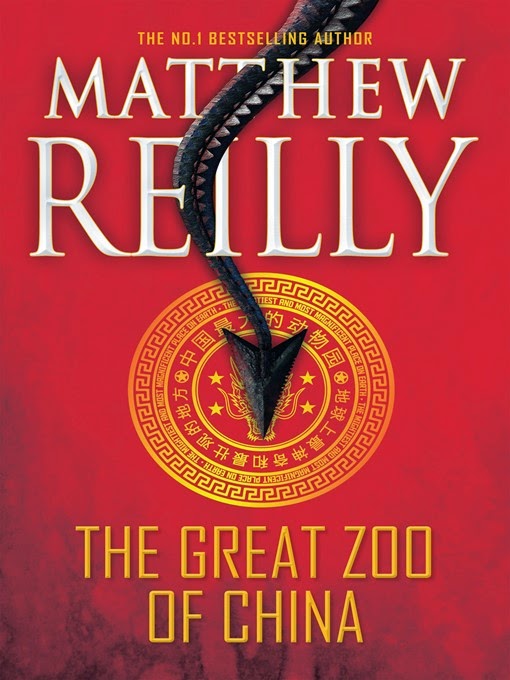
At some point while reading thriller author Matthew Reilly's new book The Great Zoo of China, you start to think it's a departure for him. After all of the Raiders of the Lost Ark-inspired ancient artefacts and booby-trapped hidden cities of the Six Sacred Stones and Five Greatest Warriors series, The Great Zoo of China is more a monster mash.

But after a while, after reading about said monsters throwing petrol tankers at people fleeing in cars and battling jet fighters in the skies, you realise he's still concerned with — as he puts it when I talked to the 40-year-old bestselling author on the phone from his Sydney home — "being fast and furious and giving people a high-tech adventure".

But something you don't realise about Reilly's work is that the urgent pacing and whiplash action is augmented by contemporary themes. Almost every industry and country is being affected by China's rise as a superpower and it was something he delved into when travelling there to research the book.
"It's funny, when you write a book that's so out there it still has to be grounded in a geopolitical reality," Reilly says. "People are just interested in China now and I like to have my finger on the pulse."

After taking the pulse of modern China, Reilly touched on one of the most insightful dimensions of what's been called the "China Dream", a curious aspect of the country's incredible rise.

"I went on a boat trip down the Yangtze River heading towards the Three Gorges dam when I got chatting with a Canadian fellow who worked on the dam," he says. "I asked what it was like and he said it was absolutely painful. Nobody will make a decision; they'll only get the foreign consultants to make the decision. He got so tired of saying 'You can do A or B', and they say 'What would you do?'"
It belies a curiously enduring lack of confidence despite awe-inspiring engineering manpower and political will (it's said China can build a whole city in a single month). But the authorities in The Great Zoo of China nevertheless unveil a project that's been in development for decades, and when it all goes wrong as soon as it's ready to be revealed to the world, you'll be reminded of another cultural touchstone.

"Anyone who's heard me speak knows Jurassic Park is the book that inspired me to be a novelist," Reilly says. "As soon as you put large reptilian creatures in an enclosure, people will make a comparison."

It makes you wonder if the book is a conscious (or not so conscious) homage to Michael Crichton, who wrote the dinosaur thriller that became the smash Steven Spielberg movie.
"In a way everything I've done is a homage to Michael Crichton," he admits. "Dinosaurs were real and Crichton was brilliant recreating them with DNA. What I've done is taken a mythological creature and had even more fun with it. I knew there'd be comparisons but I'm confident my story is completely different."

Which bring us to the central question about the monsters. They're revealed to the characters in a flourish after several chapters that really build up the anticipation, and Reilly says he considered calling the book The Great (insert name of monster here) Zoo of China.

It's not too much of a mystery when you see the image on the book's Australian cover but it still feels a little bit wrong to spoil the big reveal before you read it for yourself. Which, knowing Reilly's following, many will.

The Great Zoo of China is published by Pan Macmillan ($40 hardback, ebook $15). Matthew Reilly will be in conversation with William Yeoman this Friday at All Saints’ Auditorium, Bull Creek. He will also be doing book signings for Dymocks on Thursday and Friday. For full details visit the Dymocks website [www.dymocks.com.au/Events/StoreEvents-Western-Australia|dymocks.com.au/Events/StoreEvents-Western-Australia].

Loch Ness monster ancestor? Scottish scientists identify prehistoric reptile Dearcmhara shawcrossi

Tuesday, January 13, 2015


A giant prehistoric reptile that patrolled Scotland's waters 170 million years ago has been identified by scientists.

The creature, which resembled a menacing dolphin and grew up to four metres long, was identified by fossils from the Isle of Skye in northwest Scotland.

A team of palaeontologists, led by Edinburgh University scientists, studied fossil fragments of skulls, teeth, vertebrae and an upper arm bone unearthed on the island over the past 50 years.

They identified several examples of extinct aquatic animals – known as ichthyosaurs – which lived during the early to middle Jurassic period, including the entirely new species.

Scientists named the species Dearcmhara shawcrossi in honour of Brian Shawcross, an amateur fossil collector who gathered many of the fossils in 1959.

These were later donated to a museum, allowing scientists to study them and identify the new species.

"During the time of dinosaurs, the waters of Scotland were prowled by big reptiles the size of motor boats," said Steve Brusatte of Edinburgh University's School of GeoSciences.

"Their fossils are very rare and only now, for the first time, we've found a new species that was uniquely Scottish."

Scotland's most famous reptile, real or imaginary, is the Loch Ness monster, the myth of which draws thousands of visitors a year to Loch Ness in northern Scotland.

Scientists say traces of a 150-million-year-old dinosaur which have been found on the banks of Scotland's Loch Ness are definitely not those of the lake's legendary monster.

A Jurassic-era fossil of four perfectly preserved vertebrae from what is believed to have been a 35-foot long plesiosaur was found by a man who plucked it from shallow water on the bank of the loch.

Gerald McSorley, 67, turned it over to the National Museum of Scotland, which is conducting tests on the rare find, the first of its kind in Scotland for more than a century.

Museum spokeswoman Hannah Dolby said: "Chances that the fossil originated where it was found are very slim ... it was deposited there either by natural or artificial means.

"Borings on the fossil show it comes from a marine environment rather than a fresh water environment like the loch," she said.

Tales of a "horrible great beastie" have swirled around the 200-metre deep Scottish loch for centuries, often describing the creature as black with a fat body and serpentine neck.

Cameras beam 24-hour footage of the loch to webcams and diving teams regularly scour the chilly waters for the elusive creature.

Any hopes among Nessie enthusiasts that the fossil find might prove the existence of the monster would be groundless, scientists say.

While the fossil is about 150 million years old, Loch Ness was formed only 10,000 years ago, at the end of the last Ice Age.


AFP