Showing posts with label book. Show all posts

Dinosaur Wars: Earthfall

Thursday, July 5, 2018

Star Wars meets Jurassic Park as dinosaurs return to earth from space. Action-packed adventure for all age groups.

"Solid science and pacing that never quits." --Kay Kenyon, Philip K. Dick Award nominated author of Maximum Ice

"Fills the void since Jurassic Park. And, Hopp's book may be better." --Steve Brusatte, DinoLand Review
 

It's taken me a while to write this review. After I read the book, I wasn't sure what to make of it. I then read the other reviews and found that I agreed completely with both the low and the high star reviews.

Yes, the plot is whacky, the science is at least half fantasy, as is the military reaction, and the characters' activities--not to mention the intelligent dinos waging war on humankind. But the book was a blast to read, fast paced with accessible, if somewhat one-dimensional characters.

I think what got me, besides the whole Jurassic Park meets War of the Worlds plot, is the way the author managed to weave a lot of tongue-in-cheek humor into his non-stop, dino action. For instance, when the paleontologist, one of the main characters in the book, is rounded up with some millitary men to be the intelligent dino's dinner, he thinks to himself, as the dinosaurs he's spent his whole life studying lean over him with their jaws ready to take a bite: "So this is what they mean when they say you're consumed by your work." How can you not like puns and dinosaurs in the same book???

And there are moments of real pathos, terror, anger...the author manages to get the reader to feel the whole spectrum. Yes, including, eyerolling "you've got to be kidding me" moments. There are a lot of those, it has to be admitted. And I thought the ending was the biggest eyeroller of them all, especially how the lone For Peace dino never has a moment of angst over the humans blowing away his home base where his beloved, pregnant wife was nesting. He's STILL bent on making peace with these tasty, so-called intelligent humans.

I do think that you will enjoy this book, as I did, if you park your modern outlook and knowledge of real science, and instead let yourself channel the days of Edgar Rice Burroughs and scienece fiction adventures from the pulp fiction days of yesteryear.

Dinosaurs on the Battlefield

Friday, May 18, 2018


Victor Milán’s new novel in The Dinosaur Lords series, set in a primordial world with every species of dinosaur, large and small. The books are bloodsoaked—the basic elevator pitch is “Jurassic Park meets Game of Thrones”—specifically because the saurians aren’t around to be pets, attractions, or build a Dinotopia.

Milán employs them as scaly war engines which brings up a question pondered by generations of kids as they’ve assembled plastic dinosaur toys in their sandboxes—which are the best dinosaurs to wage war?


An enormous, excessively-fanged theropod would be the obvious choice. We’ve all daydreamed about clambering atop a Tyrannosaurus to vanquish our enemies. (Right?) But there are two problems with this plan. The first is that the carnivore might be just as likely to eat you as your enemy. A morsel is a morsel to a hungry carnivore. That, among other reasons, is probably why there haven’t been war tigers or battle wolves outside the annals of fantasy. And despite the psychological terror an armored, snarling tyrannosaur might inspire on the battlefield, it’d actually be terrible in an all-out fight. Tyrannosaurs, like all giant carnivorous dinosaurs, were bipeds. Break one of their legs, and they topple over useless and defeated.

Milán gets it. In his fantasy world, most of the war dinosaurs are herbivores that stomp around on all fours—crested hadrosaurs, horned dinosaurs, and the armored ankylosaurs. They seem like suitable stand-ins for dragons. Many had the spikes, horns, and crests to make them look intimidating enough. Despite their appearances, though, most of these dinosaurs wouldn’t have been as useful as you might expect.

READ MORE 

WARHAMMER FANTASY


Carnosaurs are large apex predators that have terrorized the darkness of the primordial jungles since the dawn of this world's existence. Considered by many as the ultimate jungle hunter, with some growing nearly two stories tall, these massive reptilian beasts are powerfully built and highly aggressive creatures, with long, muscular hind limbs and a heavy tail that is used to balance its enlarged and powerful skull. Only the Dread Saurian are above even these mighty predators. Upon scenting prey, or catching sight of even the slightest amount of movement, the Carnosaur propels itself with enormous strides, moving with a surprising speed for such a large beast.

Bastiladon, sometimes known as Living Bastions, are a mighty and hulking species of armored reptiles whose heavily armoured shell is perhaps one of the strongest within the continent of Lustria. It is a walking fortress, a living bastion covered in a rock-hard bony skin, and then further protected by massive iron-like plates — a natural armour so dense that it can, sometimes, thwart the bite of the mighty Carnosaur. Even those blows that crack the outermost armour plates cannot penetrate deeply into the beast due to the Bastiladon’s alternating layers of thick leathery skin and additional scales.

Stegadons are mighty horned reptilian beasts that have dwelt within the primeval jungles of Lustria since long before the coming of the Old Ones. They are bulky creatures whose heads are covered by armoured crests, out of which project massive horns. With bony scales and spikes shielding their bodies, there are few predators that dare challenge them. Territorial and highly aggressive, Stegadons will charge any creature that intrudes upon their habitat. Other creatures stay well clear of these herds, for fear of being trampled or gored.

Seraphon Army

Older than memory, existing for aeons unrecorded, the seraphon have ever waged an unending, savage war against Chaos. Summoned by the incredible power of the Slann Starmasters, they materialise from the energy of the stars themselves - nimble skinks, predatory saurus and hulking kroxigor, each intent on destroying the forces that have corrupted and darkened the realms almost beyond repair.


Book[s] The Dinosaur Lords by Victor Milán

A world made by the Eight Creators on which to play out their games of passion and power, Paradise is a sprawling, diverse, often brutal place. Men and women live on Paradise as do dogs, cats, ferrets, goats, and horses. But dinosaurs predominate: wildlife, monsters, beasts of burden—and of war. Colossal plant-eaters like Brachiosaurus; terrifying meat-eaters like Allosaurus, and the most feared of all, Tyrannosaurus rex. Giant lizards swim warm seas. Birds (some with teeth) share the sky with flying reptiles that range in size from bat-sized insectivores to majestic and deadly Dragons.

Thus we are plunged into Victor Milán’s splendidly weird world of The Dinosaur Lords, a place that for all purposes mirrors 14th century Europe with its dynastic rivalries, religious wars, and byzantine politics…except the weapons of choice are dinosaurs. Where vast armies of dinosaur-mounted knights engage in battle. During the course of one of these epic battles, the enigmatic mercenary Dinosaur Lord Karyl Bogomirsky is defeated through betrayal and left for dead. He wakes, naked, wounded, partially amnesiac-and hunted. And embarks upon a journey that will shake his world…

Chapter One

The Empire of Nuevaropa, Alemania, County Augenfelsen

They appeared across the river like a range of shadow mountains, resolving to terrible solidity through a gauze of early-morning mist and rain. Great horned heads swung side to side. Strapped to their backs behind shieldlike neck-frills swayed wicker fighting-castles filled with archers.

“That tears it!” Rob Korrigan had to shout to be heard, though his companion stood at arm’s length on high ground behind the Hassling’s south bank. Battle raged east along the river for a full kilometer. “Voyvod Karyl’s brought his pet Triceratops to dance with our master the Count.”

Despite the chill rain that streamed down his face and tickled in his short beard, his heart soared. No dinosaur master could help being stirred by sight of these beasts, unique in the Empire of Nuevaropa: the fifty living fortresses of Karyl Bogomirskiy’s notorious White River Legion.

Even if they fought for the enemy.

“Impressive,” the Princes’ Party axeman who stood beside Rob yelled back. Like Rob he worked for the local Count Augenfelsen—“Eye Cliffs” in a decent tongue—who commanded the army’s right wing. “And so what? Our dinosaur knights will put paid to ’em quick enough.”

“Are you out of your tiny mind ?” Rob said.

He knew his Alemán was beastly, worse even than his Spañol, the Empire’s common speech. As if he cared. He’d had this job but a handful of months, and suspected it wouldn’t last much longer.

“The Princes’ Party had the war all its own way until the Emperor hired in these Slavos and their trikes,” he said. “Three times the Princes have fought Karyl. Three times they’ve lost. Nobody’s defeated the White River Legion. Ever.”

The air was as thick with the screams of men and monsters, and a clangor like the biggest smithy on the world called Paradise, as it was with rain and the stench of spilled blood and bowels. Rob’s own guts still roiled and his nape prickled from the side effects of a distant terremoto: the warhadrosaurs’ terrible, inaudible battle cry, pitched too low for the human ear to hear, but potentially as damaging as a body blow from a battering ram.

READ MORE

Glaurung

Sunday, April 5, 2015

Glaurung fighting with dwarves by Justin Gerard

Glaurung by Markus Erdt

Glaurung was the first terrestrial, fire-breathing Dragon in Middle-earth. First of the Fire-drakes was Glaurung, the Father of Dragons. 

After only a century of brooding and growing in the dark pits of Angband, Glaurung first emerged in FA 260 in a fiery wrath, burst from the gates and startled the races of Middle-earth. Though Glaurung was not of the winged race that would later arise, he was the greatest terror of his time. He burned and ravaged Ard-galen, the land of the Elves in Hithlum and Dorthonion. However, he was not yet at his full strength, so was driven back by Fingon, the prince of Hithlum at that time, and his archers. Morgoth was displeased with Glaurung for revealing himself before he had grown to full strength, as Morgoth had planned to allow the Dragon to grow to full power before unleashing him.

To Glaurung, this attack was but an adolescent adventure, a youthful testing of strength. Terrible as he was to the Elves, his strength was barely developed, his scale armor still vulnerable to the attack of weapons; this was just a taste of his power. 

Glaurung was contained in Angband for another two centuries before he was again loosed. This was the beginning of the Fourth Battle of the Battles of Beleriand. It became known as the Dagor Bragollach when Glaurung in full power led Melkor's forces against the High Elves of Beleriand. His vast bulk and scorching fire cleared a path into the enemy armies, and with the Balrogs at his side, Glaurung led the Orcs to an astounding victory and broke the siege of Angband.

In the fifth battle, the Nirnaeth Arnoediad, Glaurung caused even more destruction, as he had fathered a brood of lesser Dragons to follow him into battle. So a great army of Elves and Men fell before the onslaught, for none could withstand the Dragonfire save the Dwarves of Belegost, who had come to battle a common foe.

Morgoth used Glaurung as well to hold the territories he gained; but force in battle was not the only power the monster knew. He brought many under his sway with the binding power of his serpent eye and hypnotic Dragon Spell. 

After Glaurung aided Morgoth during the Battle of Unnumbered Tears, he was given the assignment to complete the Sack of Nargothrond, one of the Elven fortresses in Beleriand. Glaurung came upon Nargothrond with great force, and sacked the kingdom easily. He faced Túrin, son of Húrin, at the gate and so he froze Túrin with his eyes. Túrin heard the screams of Finduilas, daughter of Orodreth, as he stood there. When the captives had been taken away, Glaurung unfroze Túrin and gave him two choices: the first to follow Finduilas, and the second to aid his mother and sister, who were suffering in Dor-lómin. Túrin chose the latter, and in this way he was deceived by the dragon, for his mother and sister were living well in Doriath. Glaurung then gathered up all the treasures of Felagund and hoarded them deep within Nargothrond's underground halls, he then sat atop his hoard, guarding it jealously, and so he rested.

Glaurung received knowledge of Morwen and Nienor's departure to seek their family members. In the forest where they were travelling, Glaurung found Nienor and caused her to lose her mind. This caused her to run through the forest "like a deer". Soon after this, Túrin found her crying on Finduilas's grave. Not knowing that she was his sister, Túrin named her Níniel (Tear maiden) and took her to his home with the folk of Brandir. There they lived for the next three years. 

After those years, Glaurung attacked the area around their home. Túrin resolved to kill the dragon. Two men went with him. One became afraid and fled, and the other was crushed by rocks. However, Túrin was able to kill Glaurung by thrusting his sword, Gurthang, into Glaurung's belly. Glaurung felt his death wound and screamed. When the dragon's blood touched Túrin, he fell into a swoon. Glaurung screamed until his strength was gone. Nienor found him there, with Túrin beside him. With his last breath, Glaurung gave Nienor her memory back, and died. Shortly thereafter, Nienor jumped into the river below, and Túrin awoke and threw himself on his sword.


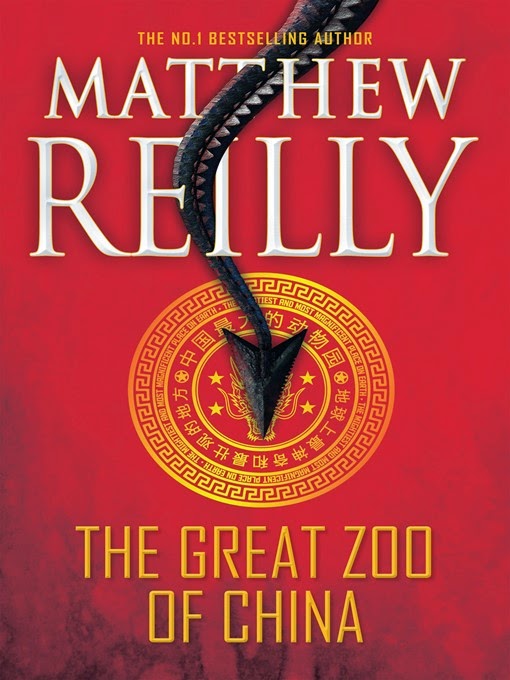
Matthew Reilly Has A Moment And Resurrects Dragons

Thursday, March 5, 2015

Bestselling author Matthew Reilly uses his latest novel to probe the rise of China as a superpower, argues Drew Turney.

At some point while reading thriller author Matthew Reilly's new book The Great Zoo of China, you start to think it's a departure for him. After all of the Raiders of the Lost Ark-inspired ancient artefacts and booby-trapped hidden cities of the Six Sacred Stones and Five Greatest Warriors series, The Great Zoo of China is more a monster mash.

But after a while, after reading about said monsters throwing petrol tankers at people fleeing in cars and battling jet fighters in the skies, you realise he's still concerned with — as he puts it when I talked to the 40-year-old bestselling author on the phone from his Sydney home — "being fast and furious and giving people a high-tech adventure".

But something you don't realise about Reilly's work is that the urgent pacing and whiplash action is augmented by contemporary themes. Almost every industry and country is being affected by China's rise as a superpower and it was something he delved into when travelling there to research the book.
"It's funny, when you write a book that's so out there it still has to be grounded in a geopolitical reality," Reilly says. "People are just interested in China now and I like to have my finger on the pulse."

After taking the pulse of modern China, Reilly touched on one of the most insightful dimensions of what's been called the "China Dream", a curious aspect of the country's incredible rise.

"I went on a boat trip down the Yangtze River heading towards the Three Gorges dam when I got chatting with a Canadian fellow who worked on the dam," he says. "I asked what it was like and he said it was absolutely painful. Nobody will make a decision; they'll only get the foreign consultants to make the decision. He got so tired of saying 'You can do A or B', and they say 'What would you do?'"
It belies a curiously enduring lack of confidence despite awe-inspiring engineering manpower and political will (it's said China can build a whole city in a single month). But the authorities in The Great Zoo of China nevertheless unveil a project that's been in development for decades, and when it all goes wrong as soon as it's ready to be revealed to the world, you'll be reminded of another cultural touchstone.

"Anyone who's heard me speak knows Jurassic Park is the book that inspired me to be a novelist," Reilly says. "As soon as you put large reptilian creatures in an enclosure, people will make a comparison."

It makes you wonder if the book is a conscious (or not so conscious) homage to Michael Crichton, who wrote the dinosaur thriller that became the smash Steven Spielberg movie.
"In a way everything I've done is a homage to Michael Crichton," he admits. "Dinosaurs were real and Crichton was brilliant recreating them with DNA. What I've done is taken a mythological creature and had even more fun with it. I knew there'd be comparisons but I'm confident my story is completely different."

Which bring us to the central question about the monsters. They're revealed to the characters in a flourish after several chapters that really build up the anticipation, and Reilly says he considered calling the book The Great (insert name of monster here) Zoo of China.

It's not too much of a mystery when you see the image on the book's Australian cover but it still feels a little bit wrong to spoil the big reveal before you read it for yourself. Which, knowing Reilly's following, many will.

The Great Zoo of China is published by Pan Macmillan ($40 hardback, ebook $15). Matthew Reilly will be in conversation with William Yeoman this Friday at All Saints’ Auditorium, Bull Creek. He will also be doing book signings for Dymocks on Thursday and Friday. For full details visit the Dymocks website [www.dymocks.com.au/Events/StoreEvents-Western-Australia|dymocks.com.au/Events/StoreEvents-Western-Australia].

Dinosaurs - Recommended Reading

Saturday, November 28, 2009

These include the anthology The Complete Dinosaur, edited by J. O. Farlow and M. K. Brett- Surman; David Norman’s Illustrated Dinosaur Encyclopedia; John Noble Wilford’s The Riddle of the Dinosaur; and Don Lessem’s Dinosaurs Rediscovered (originally titled The Kings of Creation). Almost as valuable as the Farlow and Brett-Surman anthology is the Encyclopedia of Dinosaurs (San Diego: Academic Press, 1997), edited by P. J. Currie and K. Padian. Good books on particular types of dinosaurs include John Horner and Don Lessem’s The Complete T. rex (New York: Simon and Schuster, 1993) and Peter Dodson’s The Horned Dinosaurs (Princeton, NJ: Princeton University Press, 1996). Gregory S. Paul’s Predatory Dinosaurs of the World (New York: Simon and Schuster, 1988) is interesting and contains the author’s own excellent illustrations but makes many very controversial claims about how fast these creatures ran and how they lived.

Some of the most interesting recent books on dinosaurs attempt to reconstruct their lives and habits. John Horner’s books can be particularly recommended as works that try to tell us about dinosaur behavior and lifestyles. His book Digging Dinosaurs: The Search That Unraveled the Mystery of Baby Dinosaurs (New York: Workman, 1988), cowritten with J. Gorman, tells about his discovery of dinosaur eggs and nests. These discoveries prompted Horner to name one dinosaur Maiasaura, which means “good mother lizard,” because of evidence that it kept nests and nurtured its young. A more recent book coauthored with E. Dobb, Dinosaur Lives: Unearthing an Evolutionary Saga (San Diego: Harcourt Brace, 1997), gives evidence for other aspects of dinosaur behavior.

There are two college-level textbooks on dinosaurs, Dinosaurs: The Textbook by Spencer G. Lucas (Dubuque, IA: William C. Brown Publishers, 1994) and The Evolution and Extinction of the Dinosaurs by David E. Fastovsky and David B. Weishampel (Cambridge: Cambridge University Press, 1996). Both are very good, well illustrated, and considerably livelier than the usual cut-and-dried textbooks.

A word of caution: There are many good books on dinosaurs. I have been able to list only a few of them here. However, there are also many very bad books on dinosaurs, especially books for children. These books are often written by people who do not know much about dinosaurs and who don’t mind making a few bucks by passing on their ignorance to others. Some years ago Don Lessem and other paleontologists formed the Dinosaur Society to safeguard against misinformation. If a book bears the seal of the Dinosaur Society, it will contain accurate information—otherwise, caveat emptor.

Back Lots of the Lost: The Implausibility of the Cliched "Lost World"

Monday, May 4, 2009


Paul T. Riddell

Since the Victorian period, shortly after the discovery and scientific description of the first recognized examples of the class Dinosauria, individuals have speculated on the possibilities of areas where dinosaurs and other prehistoric creatures may still exist. Back before aerial surveys and satellite photographs, the idea of lost continents brimming with tyrannosaurs and pterosaurs fevered the imaginations of fiction writers and readers. After serious exploration efforts turned up no signs of previously unknown saurians, speculation turned toward parallel evolution of dinosaurs on alien worlds, or in isolated patches of jungle unknown to humans. The "lost world" cliché soon became almost universal, demanding a Frank Frazetta canvas: mention "lost world" to nearly anyone and ask for the first images that pop up, and invariably the first response concerns cavemen (and rather shapely cavewomen) watching as a Tyrannosaurus and Triceratops duke it out in a landscape shadowed by giant volcanoes and fern trees.

The perception is popular, and certain lost worlds exist today. However, the prediluvian world of the Galapagos rift vents, with animals and bacteria probably related to the first organisms that left the confines of the vents and struck out for the wide, cold ocean just don't have the same appeal. If we don't get dinosaurs, then at least we need prehistoric mammals (usually saber-toothed cats and mammoths, although titanotheres and creodonts have their possibilities), or maybe some of the reptiles that predated the dinosaurs. They're not as impressive as T. rex, but being chased by a Lycaenops or a Dimetrodon still offers adventure and suspense. For those seeking the less familiar, the creatures of the mid-Devonian are passable, between giant four-meter-long sea scorpions and early amphibians on land and gigantic predatory fish like Dunklosteus in the oceans, and then there's always the singular (if diminutive) animals of the early Cambrian as preserved in the Burgess Shale.

READ MORE

Dinosaur Summer by Greg Bear (1998)

Saturday, March 28, 2009

Hardback cover blurb

It’s the year 1947, and nobody’s interested in dinosaurs anymore. Less than fifty years after Professor Challenger’s famed journey to the Lost World, America’s last dinosaur circus is closing down… but the adventure of a lifetime is about to begin. In a dramatic change of pace, multiple Hugo and Nebula award-winning science fiction master Greg Bear, author of Moving Mars, Anvil of Stars and Queen of Angels, presents a lavishly illustrated thriller that is certain to become a new classic of adventure beyond time…

DINOSAUR SUMMER

Peter Belzoni is dreading summer in Manhattan. Then his father, photojournalist Anthony Belzoni, offers the youth a job, and a byline in National Geographic… and a trip to South America. For Lothar Gluck Circus, once the world’s foremost dinosaur attraction, has gone bankrupt. Left behind is a menagerie of avisaurs, centrosaurs, and ankylosaurs, as well as one predatory raptor named Dagger. And now two filmmakers and the circus trainer plan to return the giants to the wild – with Peter and his dad chronicling the odyssey for Geographic. The task seems impossible. Many have died trying to bring beasts out of the Lost World, the plateau of El Grande in Venezuela, but nobody has ever attempted to transport nearly a dozen full-grown, multi-ton prehistoric creatures across continents, down rivers, through jungles, and up a mountain that has been isolated for 70,000,000 years…

The trek will strain the technologies of trains, cargo ships, barges, trucks… en route lurk robbers and hostile, trigger-happy soldiers… and each miles toward freedom excites Dagger toward an unstoppable, primal killing frenzy. When the unthinkable threatens to strand Peter and the rest of the crew in an uncharted realm, four modern Americans will face all the unknown dangers, mysteries, and terrors of El Grande…

My thoughts

Peter Belzoni gets to live out every boy’s dream: He will accompany his father on an adventure to a remote plateau in Venezuela where dinosaurs still roam. It’s a hell of a way to spend summer break.

It turns out that the Lost World discovered by one Professor Challenger is real. But in the 30 or so years since the discovery, things haven’t gone well. The Lost World was exploited for profit, and many of its animals were captured for zoos and circuses. While the public was at first captivated by the live dinosaurs, it soon lost interest as the fad came and went. King Kong, shot with real dinosaurs, was a box-office flop, and the last dinosaur circus is closing down. The owner of the circus, Lothar Gluck, wants to return his dinosaurs to the Lost World, now a protected sanctuary. Peter and his father will accompany the expedition, but after a bad turn of events, they’ll find themselves stranded in the Lost World, where things far more deadly than dinosaurs roam.

Dinosaur Summer is an unofficial sequel to Sir Arthur Conan Doyle’s The Lost World from Greg Bear, a writer better known for hard sci-fi. It’s a fun read that’s really meant for younger audiences. The illustrations by Tony DiTerlizzi, while excellent, reinforce that fact. The book is a tribute to the filmmakers that Bear grew up with – stop-motion pioneers Ray Harryhousen and Willis O’Brien, and King Kong creators Merian Cooper and Ernest Schoedsack. In fact, all four have major roles in the novel.

A couple critics have complained that Dinosaur Summer was Bear’s overt attempt to write a novel that would be turned into a movie. And yes, it’s true the book was published while Jurassic Park was still all the rage (although, contrary to the cover blurb, the book doesn’t feature a “raptor,” but rather an allosaurus descendant referred to as a “venator”). I think this novel was a labor of love for Bear, an attempt by the author to recapture part of his childhood. It’s light, breezy entertainment and should be accepted as such.

Trivia
  • Unlike in Doyle’s original novel, there are no ape men or Ice Age mammals roaming Bear’s lost world. However, there are several new creatures not known in the fossil record. Bear imagines a lost world where evolution doesn't stand still, so while there are dinosaurs that have changed very little in 65 million years, there are also animals that have evolved no where else, most noticeably the book’s villain, the Stratoraptor,
  • The illustrator, Tony DiTerlizzi, is a well-known children's book illustrator. His web site includes several examples of his work, but nothing from Dinosaur Summer, unfortunately..
  • Dinosaur Summer won the first Endeavor Award, a science fiction award for writers from the Pacific Northwest.

Bones of the Earth by Michael Swanwick (2002)

Hardback cover blurb

Paleontologist Richard Leyster has achieved professional nirvana: a position with the Smithsonian Museum plus a groundbreaking dinosaur fossil site he can research, publish on, and learn from for years to come. There is nothing that could lure him away – until a disturbingly secretive stranger named Griffin enters Leyster's office with an ice cooler and a job offer. In the cooler is the head of a freshly killed Stegosaurus.

Griffin has been entrusted with an extraordinary gift, an impossible technology on loan to humanity from unknown beings for an undisclosed purpose. Time travel has become a reality millions of years before it rationally could be. With it, Richard Leyster and his colleagues can make their most cherished fantasy come true. They can study the dinosaurs up close, in their own time and milieu.

Now, suddenly, individual lives can turn back on themselves. People can meet, shake hands, and converse with their younger versions at various crossroads in time. One wrong word, a single misguided act, could be disastrous to the project and to the world. But Griffin must make sure everything that is supposed to happen does happen – no matter who is destined to be hurt... or die.

And then there's Dr. Gertrude Salley – passionate, fearless, and brutally ambitious – a genius rebel in the tight community of "bone men" and women. Alternately both Leyster's and Griffin's chief rival, trusted colleague, despised nemesis, and inscrutable lover at various junctures throughout time, Salley is relentlessly driven to screw with the working mechanisms of natural law, audaciously trespassing in forbidden areas, pushing paradox to the edge no matter what the consequences may be. And, when they concern the largest, most savage creatures that ever lived, the consequences may be terrifying indeed.

My thoughts

Few dinosaur novels came out with as much promotion as Bones of the Earth received when it was released in 2002 (the Jurassic Park novels being an obvious exception). Michael Swanwick already had won the Hugo award in 2000 for his short story, “Scherzo with Tyrannosaur,” which was something of early incarnation of “Bones of the Earth.” The publisher, Eos (a division of HarperCollins), heavily advertised the book though its web site, even allowing web users to e-mail a series of dinosaur-themed short stories to friends and family.

Bones of the Earth lived up to the hype. It’s easily one of the best dinosaur novels ever written. The story focuses on three protagonists: paleontologist Richard Leyster; his occasional lover Gertrude Salley, a woman who doesn’t like playing by the rules; and Griffin, Gertrude’s occasional lover and the man in charge of enforcing the rules. A mysterious race of beings has given humanity the gift of time travel, but there are complications. It turns out changing the past isn't so hard. Griffin’s job is to ensure that history stays history or the gift will be taken away. That’s not so easy, especially when creationist terrorists are determined to prove themselves right at all costs, and when Gertrude has plans of her own.

To give away more would be spoiling the fun of the novel. Bones of the Earth takes a little time to get going. It’s not until about halfway through the book that a story starts to materialize. But it’s a wonderful story, filled with believable characters and intriguing speculation about dinosaur ecology. The prose is a little lazy – sometimes the book reads more like a movie script than a novel. Yet that’s the only shortcoming I can come up with about this excellent work.

Trivia
  • The cover art for "Scherzo with Tyrannosaur" (Asimov's Science Fiction, 1999) features the author with his wife.

Raptor Red by Robert T. Bakker (1995)

Hardback cover blurb

A pair of fierce but beautiful eyes looks out from the dull green undergrowth. The eyes follow every movement in the great herd of plant-eating dinosaurs that mills around the open meadows, moving back and forth with the rapid scanning of a hunter who is thinking about everything she sees. She is an intelligent killer…

So begins one of the most extraordinary novels you will ever read. The time is 120 million years ago, the place is the plains of prehistoric Utah, and the eyes belong to one of the most unforgettable heroines you will ever meet. Her name is Raptor Red, and she is a female Utahraptor dinosaur.

Raptor Red’s tale begins with tragedy. She and her mate are stalking prey, a giant astrodon feeding in a nearby meadow. They approach silently and attack with deadly force. But at the moment of triumph, something goes terribly wrong and Raptor Red’s mate is killed. It is the beginning of a yearlong odyssey of survival, a thrilling story told by leading paleontologist Robert T. Bakker. Now, in Raptor Red, he dramatizes his revolutionary theories in a one-of-a-kind tale.

Raptor Red strikes out on her own, and before long she has rejoined her sister’s clan. Together they will hunt and devour iguanodons, brave a monstrous storm and the ensuing flash flood, migrate toward the western ocean to escape powerful predators, and eventually move north to a snowy mountain region in a desperate attempt to escape the threat of the deadly acrocanthosaurs.

At the same time, Raptor Red must obey nature’s command to find a new mate. But when a bold and graceful young male presents himself, she is stymied by her conflicting loyalties to her sister’s brood and her own powerful impulses to mate and produce chicks of her own. On a snowy mountaintop in the frozen north, Raptor Red’s search for a new home and a new mate will culminate in a thrilling climax.

Painting a rich and colorful picture of her lush, exotic prehistoric world, the novel is convincingly told from within Raptor Red’s mind, revealing the powerful instincts and Darwinian forces that shape her remarkable consciousness. Her story is filled with a unique cast of characters that includes a white pterodactyl, a giant prehistoric crocodile, a small furry aegialodon, hulking astrodons, and an incredible range of other exotic creatures.

Raptor Red is a completely unique and utterly compelling story of a year in the life of a dinosaur – and is sure to be one of the most talked-about books of the year.

My thoughts

The above cover blurb pretty much gives away the entire plot of the book, so there really isn’t any need to summarize it again. Raptor Red is told from the point of view of a female Utahraptor as she struggles to survive in her early Cretaceous world. Bakker, a famous paleontologist, is aiming for realism so this isn’t Watership Down with talking dinosaurs instead of rabbits. His animals behave more or less like the real thing, although Raptor Red herself comes across as a bit too smart and emotional at times.

One result of Bakker’s approach is that Raptor Red’s story is pretty simple as far as novels go. There are no plot twists or any attempts at grand themes. It’s simply a tale about an animal living in her environment. The exotic nature of the setting keeps the novel from becoming trite after the first few chapters, and Bakker’s quirky sense of humor comes across in several passages.

More than anything, Raptor Red serves as a vehicle for Bakker to give science lessons in a user-friendly format. The paleontologist is well-known for championing the idea of active, warm-blooded dinosaurs. It probably should come as no surprise then that the very first illustration in the novel features Raptor Red on a snowy mountainside, a place you wouldn’t find cold-blooded reptiles. Many of Bakker’s more radical theories are far from universally accepted, but other than in a few places, he doesn’t really delve into them.

Chances are you will still find Raptor Red in the science fiction section of your local bookstore, the paperback sporting a holographic cover. The book has had a remarkable shelf life for a work of paleofiction. It’s worth picking up a copy if you’re a fan of dinosaurs.

Trivia

  • There seemed to be a time, not long ago, when every TV dinosaur documentary had to feature at least one interview with Bakker. He is instantly recognizable with his beat-up cowboy hat and his long hair and beard. He also served as the inspiration for the character of Dr. Robert Burke in the movie The Lost World: Jurassic Park. Burke meets a rather nasty end in the jaws of a T. rex in the film.
  • The Utahraptor was co-discovered by paleontologist James Kirkland, who has also authored a work of dinosaur fiction. He co-wrote the Star Trek novel First Frontier with Diane Carey.

Return to Eden by Harry Harrison (1988)

Note: This is the final book of the West of Eden trilogy, starting with West of Eden. Spoilers ahead if you haven’t read the first book, reviewed below.

Paperback cover blurb

In West of Eden and Winter in Eden, master novelist Harry Harrison broke new ground with his most ambitious project to date. He brought to vivid life the world as it might have been, where dinosaurs survived, where their intelligent descendants, the Yilane, challenged humans for mastery of the Earth, and where the human Kerrick, a young hunter of the Tanu tribe, grew among the dinosaurs and rose to become their most feared enemy. Working in collaboration with an international team of scientific experts, Harrison created a believable, richly detailed world rivaling Frank Herbert’s Dune and Jean Auels’s The Clan of the Cave Bear in the majesty of its scope and conception.

Now, in Return to Eden, Harrison brings the epic trilogy to a stunning conclusion. After Kerrick rescues his people from the warlike Yilane, they find a safe haven on an island and there begin to rebuild their shattered lives. But with fierce predators stalking the forests, how long can these unarmed human outcasts hope to survive? The small band of humans have no choice but to confront their fate head on. And, of course, Kerrick cannot forget Viante, his implacable Yilane enemy. She’s been cast out from her kind, under sentence of death, but how long will her banishment last? For her strange attraction to Kerrick has turned into a hatred even more powerful than her instincts – an obsession that compels her to hunt down Kerrick and kill him.

My thoughts

Return to Eden is the “threequel” that can be easily skipped without any worries that you have left the story arc started in West of Eden incomplete. Most of the plot threads are resolved in the second book of the series, Winter in Eden. The result is the characters in Return to Eden have nothing to do, and the book lacks any real plot, instead reading like a grossly bloated epilogue of the first two novels. Kerrick, having made the world safe for humanity, now focuses on raising his family and finding a home for his tribe. The Daughters of Life slowly build their peaceful society in the Amazon. And Viante, now an outcast, plots her revenge. These separate storylines are drawn out over a tedious 400 pages, coming together in the end in a whopping anticlimax.

By now the alternate world of the Yilane has lost its charm, and the lack of any real story makes this book a difficult one to read through to the end. The science, which was dated when West of Eden was first published six years previously, was even more dated when Return to Eden hit bookstores. And Harrison seems to have lost interest in the setting he created. The novel feels like it was written mainly to fulfill a contractual obligation to the publisher to turn out a trilogy. Unless you have a burning desire to learn about the ultimate fates of many of the characters to the first two books, there is no reason to pick up Return to Eden.

Trivia

  • The entire trilogy was recently republished, although I’ve never had any trouble finding the original books in used bookstores.
Return in Eden has a short Wikipedia entry.

Winter in Eden by Harry Harrison (1986)

Note: This is the second book of the West of Eden trilogy, starting with West of Eden. Spoilers ahead if you haven’t read the first book, reviewed below.

Paperback cover blurb

TWO BOLD CULTURES STRUGGLE FOR SURVIVAL…

WINTER IN EDEN

Harry Harrison, an acknowledged master of imaginative fiction, broke new ground in West of Eden. He brought to vivid life the world as it might have been, where dinosaurs survived, where their intelligent descendants challenged humans for mastery of Earth, where a young hunter named Kerrick grew among the dinosaurs and rose to become their most feared enemy.

Now, the awesome saga continues in Winter in Eden… A new ice age threatens Earth. Facing extinction, the dinosaurs must employ their mastery of biology to swiftly reconquer human territory. Desperately, Kerrick launches an arduous quest to rally a final defense for humankind. With his beloved wife and young son, he heads north to the land of whale hunters, east into the enemy’s stronghold, and south to a fateful reckoning with destiny.

Not since Dune has there been a work of such majestic scope and conception – a monumental epic of passion, courage and triumph.

My thoughts

Winter in Eden starts almost immediately after the events of the first book, with the humans celebrating their victory in driving the Yilane from their shores. Kerrick, however, is troubled with the knowledge that it will be a short-lived celebration. The Yilane will return in full force, and despite their initial success, the Stone Age humans still are no match for the technologically superior reptiles. So Kerrick takes off on a journey to the Yialne homeland, hoping to find some way of single-handedly turning back their invasion.

Meanwhile, the Yilane Vinate is plotting her revenge against Kerrick, and hopes to lead the invasion force that will reclaim the lost territories. And while all this is happening, a group of peace-loving Yilane flee to the Amazon basin, where they seek to found a society radically different from that of the rest of their xenophobic species. Once there, they make a surprising discovery.

Winter in Eden is an entertaining sequel that nonetheless suffers from some of the “been there, done that” syndrome that plagues most sequels. This time, however, the story lets the reader to explore a larger portion of the world Harrison created, allowing the exotic setting to remain fresh. The story itself isn’t as well-paced as the one in the first book, so even though Winter in Eden is 100 pages shorter, it feels like a longer read. And the author had to once again rely on a dues ex machina ending to resolve the desperate situation he put his humans in. Many of the problems with the science in the first book remain in the sequel, although Harrison does introduce some interesting twists in evolution this time around.

Nitpicking aside, Winter in Eden remains a worthy follow-up to West of Eden. Most of the plot threads started in the first book are resolved in the sequel, so even if you never read the third book in the trilogy, you won’t be left feeling the story is incomplete.

Trivia

  • The entire trilogy was recently republished, although I’ve never had any trouble finding the original books in used bookstores.
Winter in Eden has a short Wikipedia entry.

West of Eden by Harry Harrison (1984)

Paperback cover blurb

IMAGINE THE WORLD AS IT MIGHT HAVE BEEN…

THE WORLD WEST OF EDEN

From a master of imaginative storytelling comes an epic tale of the world as it might have been, a world were the age of dinosaurs never ended, and their descendants clashed with a clan of humans in a tragic war for survival.

It is the tale of Kerrick, a young hunter who grows to manhood among the dinosaurs, escaping at last to rejoin his own kind. His knowledge of their strange customs makes him the humans’ leader, the dinosaurs’ most feared enemy.

My thoughts

West of Eden is the start of a trilogy of novels set on an alternate earth where the dinosaurs never went extinct and have survived to the modern day. The asteroid (or comet) that killed off the great reptiles missed entirely, so mammals never got the chance to take over. One group of reptiles, the mosasaurs, have evolved into the intelligent but cold-blooded Yilane. However, humans also have evolved in North America, where the chilly climate has allowed mammals to out-compete the cold-blooded dinosaurs of Harrison’s world. A coming ice age is forcing the Yilane to spread out to find new territory, resulting in a violent clash between the two species.

West of Eden is essentially a more literary take on One Million Years B.C., although Harrison would probably loathe hearing it described it as such. Nonetheless, through the genre of alternate history, he managed to figure out a way to place dinosaurs and cavemen side-by-side and still keep some measure of plausibility in the story (more on that in a bit). The plot isn’t as original as the setting, but it serves its purpose. Kerrick, the main character, is captured by the Yilane as a small boy after the intelligent reptiles wipe out his tribe. He grows up among them, learning their language, their customs and some of their technology, before he is rescued by the leader of another human tribe. The Yilane want to exterminate the humans, seeing them as little more than vermin. Only Kerrick’s special knowledge of the reptiles will be able to save the human race.

What works best about the novel is the Yilane. Harrison spent a great deal of time crafting the species and actually sought out the help of two scientists in designing their biology and their language. Females are dominant, with the males giving birth. Their entire society is defined by their cold-blooded physiologies: They have no concept of metallurgy, because their bodies can’t stand the heat of an open flame, so their civilization is instead based on millions of years of selective breeding and genetic manipulation of other organisms. They make fascinating villains. Still, from a purely scientific point of view, it should be pointed out that the Yilane are impossible given it takes a warm-blooded metabolism to support human-like intelligence. And the species seems a little too alien for anything that could have evolved on earth. Why Harrison chose to have them descend from mosasaurs rather than a land-dwelling dinosaur is a mystery to me.

Given the effort he put into his villains, it’s too bad Harrison didn’t spend any time fleshing out the rest of his alternate world. Instead of having dinosaurs evolve in new and weird forms after 65 million years of evolution, he just plops in creatures known from the fossil record, even if they were already extinct by the time the asteroid came crashing down. The same is true for the mammals, which have evolved into their ice age forms rather than into forms fitting the alien environments they live in. The dinosaurs of Harrison’s world also are depicted as sluggish and cold-blooded despite the fact that other science fiction writers had already embraced more modern theories about active dinosaurs by the time the author was penning West of Eden. Harrison shows a remarkable disinterest in paleontology given the subject matter of the novel, and I wouldn’t be surprised if most of his research of the science came from reading a couple children’s books about dinosaurs.

That said, West of Eden still works as an old-fashioned adventure story with a good sense of wonder. The Yilane are appropriately evil (although they do have good individuals), and it’s easy to sympathize with the Stone Age humans who are trying to avoid genocide at the hands of a technologically superior race. The only let down story-wise is the deus ex machina ending. It’s a book worth reading, even if more science-literate readers will be left wishing Harrison had used a little more imagination in crafting his world.

Trivia

  • West of Eden was republished in 2004, although I’ve never had any trouble finding copies of the book in used-book stores.

READING MATERIALS

Wednesday, March 4, 2009


These include the anthology The Complete Dinosaur, edited by J. O. Farlow and M. K. Brett- Surman; David Norman’s Illustrated Dinosaur Encyclopedia; John Noble Wilford’s The Riddle of the Dinosaur; and Don Lessem’s Dinosaurs Rediscovered (originally titled The Kings of Creation). Almost as valuable as the Farlow and Brett-Surman anthology is the Encyclopedia of Dinosaurs (San Diego: Academic Press, 1997), edited by P. J. Currie and K. Padian. Good books on particular types of dinosaurs include John Horner and Don Lessem’s The Complete T. rex (New York: Simon and Schuster, 1993) and Peter Dodson’s The Horned Dinosaurs (Princeton, NJ: Princeton University Press, 1996). Gregory S. Paul’s Predatory Dinosaurs of the World (New York: Simon and Schuster, 1988) is interesting and contains the author’s own excellent illustrations but makes many very controversial claims about how fast these creatures ran and how they lived.

Some of the most interesting recent books on dinosaurs attempt to reconstruct their lives and habits. John Horner’s books can be particularly recommended as works that try to tell us about dinosaur behavior and lifestyles. His book Digging Dinosaurs: The Search That Unraveled the Mystery of Baby Dinosaurs (New York: Workman, 1988), cowritten with J. Gorman, tells about his discovery of dinosaur eggs and nests. These discoveries prompted Horner to name one dinosaur Maiasaura, which means “good mother lizard,” because of evidence that it kept nests and nurtured its young. A more recent book coauthored with E. Dobb, Dinosaur Lives: Unearthing an Evolutionary Saga (San Diego: Harcourt Brace, 1997), gives evidence for other aspects of dinosaur behavior.

There are two college-level textbooks on dinosaurs, Dinosaurs: The Textbook by Spencer G. Lucas (Dubuque, IA:William C. Brown Publishers, 1994) and The Evolution and Extinction of the Dinosaurs by David E. Fastovsky and David B. Weishampel (Cambridge: Cambridge University Press, 1996). Both are very good, well illustrated, and considerably livelier than the usual cut-and-dried textbooks.

A word of caution: There are many good books on dinosaurs. I have been able to list only a few of them here. However, there are also many very bad books on dinosaurs, especially books for children. These books are often written by people who do not know much about dinosaurs and who don’t mind making a few bucks by passing on their ignorance to others. Some years ago Don Lessem and other paleontologists formed the Dinosaur Society to safeguard against misinformation. If a book bears the seal of the Dinosaur Society, it will contain accurate information—otherwise, caveat emptor.


Subterranean by James Rollins (1999)

Monday, February 23, 2009


Paperback cover blurb

TRAVEL TO THE BOTTOM OF THE EARTH…

to a place you never dreamed existed.

BENEATH THE ICE…

a hand-picked team of specialists makes its way toward the center of the world. They are not the first to venture into this magnificent subterranean labyrinth. Those they follow did not return.

OVER THE ROCKS… ACROSS THE YAWNING CAVERNS…BEYOND THE BLACK RIVER…

You are not alone.

INTO THE DARKNESS…

where breathtaking wonders await you—and terrors beyond imagining…Revelations that could change the world—things that should never be disturbed…

AT THE BOTTOM OF THE EARTH IS THE BEGINNING.
KEEP MOVING…

toward a miracle that cannot be…toward a mystery older than time.

My thoughts

It takes a lot of nerve to write a lost world story set in the modern day, particularly one that borrows heavily from Journey to the Center of the Earth. But that’s exactly what we have in this techno-thriller.

Subterranean opens when the two main characters, paleoanthropologist Ashley Carter and expert caver Ben Brust, are recruited by the U.S. military to investigate an enormous cavern in Antarctica. There are archaeological ruins inside the cave dating back before humankind had evolved. Who -- or more precisely, what -- built the ruins? The answer lies deeper in the cave system. Carter and Brust will lead an expedition into the depths of the Earth to find out, a journey that a previous team attempted, but never returned.

The monsters populating Subterranean are not prehistoric survivors in the strictest since, but the plot and the setting rely heavily on paleontology, so I'm not bending the rules too much. The novel is about finding out what creatures inhabited Antarctica in the 30-million-year gap between the extinction of the dinosaurs and the coming of the ice. Many authors would've used aliens to explain away the pre-human ruins, and I will give Rollins credit for coming up with a more imaginative and more interesting idea.

That said, Subterranean isn't a good book by any stretch of the imagination, with boring characters and frequent action sequences that defy logic. The main villain will offend some readers because of the ethnic stereotyping, and the monsters will feel very familiar to anyone who has seen Jurassic Park. Still, for some reason, I liked it. Why? I'm not quite certain. Perhaps because it is an old-fashioned lost world story with an appropriate sense of mystery and wonder. Or maybe because I read it at a time in my life when I was looking for some popcorn-movie escapism, and it fit the bill.

Subterranean is a good "bad book" -- not one I could recommend if you prefer your literature to be, well, literary, but a fun one as long as you don't take it seriously. Be warned that it does weigh in at a whopping 430 pages, which is about 130 pages more than the author honestly needed to tell the story.

Trivia
  • James Rollins is the pen name for veterinarian and amateur spelunker Jim Czajkowski. He has written several thrillers where evolutionary biology and archeology are the main focus.

A Journey to the Center of the Earth by Jules Verne (1864)


This is where paleo-fiction started.

A Journey to the Center of the Earth by Jules Verne was first published in 1864. The famous story is the first major work of fiction to feature prehistoric creatures surviving to the modern day.* Ironically, there are no true dinosaurs in the novel, since the beasts hadn’t captured the public’s imagination at the time the book was written.

The novel is narrated by Axel, a young man who is apprenticing under his geologist uncle, Professor Otto Lidenbrock. The two come across a cryptic manuscript alleging that a passageway to the center of the Earth exists inside an extinct volcano in Iceland. It’s a crazy claim, but Lidenbrock is open-minded -- or gullible -- enough to mount an expedition to the volcano in hopes of making the greatest scientific discovery of his time. The two are joined by a guide, and together the trio descend into the bowels of the Earth, finding a lost world hidden for millions of years. Getting out will be a different matter, however.

That’s admittedly a short description of a novel that has had a profound influence on science fiction, but the story is so well-known that most people know it by heart. A Journey to the Center of the Earth has been adapted into comics, cartoons, video games and movies numerous times, although few have been faithful to the source material. The best-known adaptation is probably a 1959 movie starring James Mason and country gospel star Pat Boone. (Boone recently called evolution a “false religion” in an opinion column, apparently forgetting that he once starred in a dinosaur movie.)

The book itself is one of Verne’s more famous titles, but I’ve never really considered it one of his better works. It’s a bit sluggish in parts, and it lacks any particularly memorable characters such as Captain Nemo from 20,000 Leagues Under the Sea. The humor seems forced by modern standards, and the whiny narrator can come across as annoying rather than funny.

Nonetheless, it would be unfair of me to leave you with the impression that this is a bad book. While it may not be Verne’s best, it’s still fun. There is a terrific sense of wonder in it missing from most of today’s science fiction. Verne just throws wonder after wonder at the reader, so much so that it isn’t until you’re near the end of the novel that you realize it doesn’t have much of an actual plot. No adaptations have really captured the full extent of Verne’s imagination, so even if you have seen two or three versions of the story, you’re still likely to be surprised by what the explorers find in the underground world they discover.

Also, how many science fiction novels are there where the authors write so lovingly about geology? It’s a topic that most writers find drab compared to quantum physics or space travel, but is just as fascinating in its own right. Paleontology really isn’t the central focus of A Journey to the Center of the Earth, and it’s pretty clear from reading the novel that Verne considered it a branch of geology rather than a separate science. The prehistoric creatures here are just window dressing, although when Verne does use them, he does so for maximum effect.

The novel is available for free on many places on the Internet, including this Web site.

* Some of the above information about the novel came from Dinosaurs in Fantastic Fiction by Allen A. Debus.

THE LOST WORLD (2001 FILM)

Thursday, January 22, 2009


Directed by: Stuart Orme

Written by: A. Conan Doyle (novel) Adrian Hodges

Starring: Bob Hoskins

James Fox

Peter Falk

Release date(s)2001

Running time: 150 min.

Country: U.K. / U.S.A. / Germany

Language: English

The Lost World is a 2001 adaptation of the novel by Arthur Conan Doyle, directed by Stuart Orme and adapted by Adrian Hodges. It was produced by the BBC and broadcast on BBC1 in the UK and A&E in the United States. It consisted of two 75-minute episodes which were first aired in the UK on the 25th and 26th of December, 2001, and in the USA on October 6 and 7, 2002.

Bob Hoskins played Professor Challenger and was supported by James Fox, Peter Falk, Matthew Rhys, Tom Ward and Elaine Cassidy.

Plot

While on a journey through the remote regions of the Amazon rainforest, Challenger (Hoskins) has an animal shot, which turns out to be a prehistoric pterosaur. During a lecture at the London Museum of Natural History, he argues that it is genuine and that he shot it several months ago. The lecturer, Professor Summerlee (Fox) dismisses it as nothing more than a clever hoax, as do several others. Eventually ambitious John Roxton (Ward), a noted hunter and womanizer, and Daily Gazette columnist Edward Malone (Rhys) announce they will volunteer for the expedition.

On the boat, Challenger shows a sarcastic Summerlee and his expedition members a map, drawn up by a Portuguese man called Padre Mendoz who ended up in the remote, uncharted area of Brazil which Challenger claims prehistoric creatures thrive. Most notably, there is a plateau, which would supposedly isolate the inhabitants from the evolutionary mainstream for millions of years. Upon arrival, Roxton begins flirting with Agnes (Cassidy), the niece of Reverend Theo Kerr, a priest who disregards the idea of evolution.

They eventually find the plateau. They cross over a log bridge, which the Reverend suddenly pushes into a deep crevice in an abrupt mood swing, thus leaving them stranded. In the jungle, Edward makes 'friends' with a hypsilophodont, and the stunned group spot an Iguanodon, and then a group of pterosaurs who attack and injure Summerlee.

They retreat to the forest where Edward is scared out of a tree by an ape that, in his words "looked almost human". In the middle of the night, while they are gathered around the campfire whispering about "Who will miss them if they die" they are attacked by a large carnosaur, which is later identified by Summerlee as an allosaur.They then search for and find a large lake in the centre of the plateau which Malone had discovered while up the tree,and he names it "Gladys" while Roxton and the professors rest by the beach. Edward and Agnes walk off along the beach until the Allosaur from last night emerges from the forest and drinks from the lake, but soon notices them as they run into the forest. In the cliffhanger ending of the first episode, the carnivore pursues them through the borders of the forest until they all fall into a pit, where the Allosaur is killed after being impaled on two wooden spikes.

After making their escape, they find out that Challenger and Summerlee have been kidnapped by the ape-men. The apes take them to an enclosed sacrificial chamber, where they are placed on a thick sheet of rock which is covered with blood. The sun shines through a crack and the beasts place Summerlee's head in a groove on the plate of rock, about to smash his head with a large stone when Roxton and the group start shooting all the ape-men. Challenger tries to save the creatures, calling them "The missing link between animal and human" upon leaving the animals territory, the group also rescue an Indian chief's son. The tribe recognizes Challenger as Padre Mendoz - the Portuguese man that returned from the plateau and drew up a map of the area. They are also told of how a man, whom they thought was the Devil, came to visit them and then left, sealing off the cave that was their only route out of the plateau. The two groups cooperate very well together, with Challenger sitting by the chief's side, and Roxton marrying the patriarch's daughter. However, the presence of the ape-men disturb the tribes people but, with Professor Challenger's protection, they remain safe from harm and are kept in a wooden cage/construction on the border of the village.

However, two Allosaurs attack the village after weeks of harmony. After causing much death and destruction, the first Allosaur is killed by Roxton and his Elephant gun but the second, larger Allosaur kills the chief. In an act of kindness, Agnes and Malone set the ape-men loose and they flee back into the jungle. One psychotic ape gets its hands on a knife and keeps an eye on Roxton. Edward Malone eventually kills the larger dinosaur, but is a little late to save the chief and several of the Indians. He is critically injured, and dies in the arms of his son, who blames the white intruders. During the attack, Summerlee blows up the debris blocking their only escape route, and after the chief's son assumes command, the outsiders flee while Roxton stays behind to stall them. The ape with the knife stabs Roxton in the torso, injuring him while the son of the chief shoots the mad ape while it stands atop a rocky mound, growling. Outside, the Reverend comes to block the remaining group's way, intending to kill all of them and seal off the cave again, insisting that the plateau is "Not part of God's kingdom", and calling it "the work of the devil". While struggling with Summerlee, he accidentally shoots himself in the chest and dies.

The explorers go back to London, where the juvenile pterosaur that Challenger brings back escapes. Afterwards, Malone and Summerlee urge Challenger to end the whole affair so that the plateau and its inhabitants can exist in peace; the pterosaur is dismissed as an Amazonian vulture, while the articles Edward sent back are passed off as extracts of a novel he is writing. Edward confesses he loves Agnes, who tells him the same, and they kiss in the great hall of the museum where the crew have been exposed as frauds. In the final scene, Roxton is shown alive and well, and still happily married to Muree.

Bestiary

Allosaurus

Entelodont

Hypsilophodon

Iguanodon

Pteranodon summerlensis

Diplodocus

Brachiosaurus (seen at a distance)

Pithecanthropus challengeris

[edit]Differences from Doyle's novel

This article does not cite any references or sources. Please help improve this article by adding citations to reliable sources. Unverifiable material may be challenged and removed. (August 2008)

In the book, the plateau is in Venezuela. In the 2001 adaptation, it was in Brazil.

The prehistoric lake scene from the book is absent.

In the book, Edward Malone doesn't meet another love interest besides Gladys.

In the book, the Indians deliberately call the Allosaurus to the village, where they kill them and eat them for dinner. In the film, the ape men call the dinosaurs to the human settlement.

The characters Gomez and Zambo - indeed, any of the Indians - are not mentioned. They are replaced by Reverend Theo Kerr, and his niece Agnes.

Following the attack on the campfire by the Megalosaurus in the book, neither Summerlee nor Challenger are immediately able to identify even the family of carnivore that attacked them, whereas Summerlee immediately dubs the animal an allosaur upon being asked by Lord Roxton. Also, the campfire attack is fairly different from the book. In the novel, the group spot the Megalosaurus, and before it has a chance to attack, Roxton scares it off with fire. In the film, the group are completely taken by surprise and the allosaur almost gains the upper hand, before being scared away with fire.

The ape men are present in both the novel and film, but the other humanoid tribe, rather than a prehistoric species, consists of the surviving members of a Portuguese expedition.

In the book, Edward Malone says he will join Roxton on the next expedition to the plateau. In the film, he tentatively offers to Professor Challenger, who says he'll be in touch.

Lord John Roxton escapes the plateau in the book. In the BBC adaptation, he is stabbed by an Ape Man, and supposedly dies. However, at the end of the second episode, we see him still happily married to Muree, the former patriarch's daughter.

The diamonds found in the blue clay in the book do not feature in the mini-series.

Dinosaurs in Science Fiction Literature

Wednesday, January 21, 2009

(compiled by M.K. Brett-Surman)A Guide to Stories, Novels, Anthologies and Pulps.
(This list does NOT include comics, Young Adult or juvenile stories.)L(please send additions/corrections to brettsur@si.edu)

The original "DINOSAURS IN SCIENCE FICTION" file was compiled by Michael K.Brett-Surman in the 1980s. A printed version of this file, covering publications only toDecember, 1996, appeared in the award winning book THE COMPLETE DINOSAUR, IndianaUniversity Press, edited by J.O. Farlow and M.K. Brett-Surman, 1997. That version iscopyrighted by Indiana University Press © 1997.

This version is copyrighted by M.K. Brett-Surman © 2006. All U.S. and internationalrights reserved. Copying, distributing, or publishing the data in any manner or media for personal or corporate gain is not permitted. The DINOSAURS IN SCIENCE FICTION file is presented for non-commercial, personal use only.

Thanks to the following people for additions and corrections: Forrey Ackerman, DeanHannotte, Donald F. Glut, Jeff Poling, Walter J. Williams, Stephen Dedman, Robert Sawyer,Tom Tyrberg, Bob Walters, Walter J. Williams, Thomas Diehl, Stephan Pickering, Steve Carper,Tom Hopp, Tom Wright, “ValourX”, “majalak”, and Václav Petr.The last update was in May, 2006.