New find sheds light on dinosaur flight

Wednesday, July 16, 2014


The dinosaur's long tail probably worked like the elevator and flaps of an aircraft, helping to control the animal's pitch and reduce speed for landing (Stephanie Abramowicz/Dinosaur Institute NHM)

Stuart Gary
ABC


Fossils of the largest dinosaur capable of flight have been discovered in China, according to a new study.

A report in the journal Nature Communications, says the 1.2-metre-long raptor named Changyuraptor yangi, was covered with plumage, including 30-centimetre-long tail feathers.

This discovery shows this 125-million-year-old raptor was flying long before birds split off from dinosaurs, says one of the study's authors Dr Luis Chiappe, a palaeontologist at the Natural History Museum of Los Angeles County.

"What makes this special is its size," says Chiappe.

"This four-kilogram dinosaur is much bigger than previous dinosaurs that we thought could fly, so it extends our understanding of what these animals were capable of doing."

The long feathered tail is thought to have played an important flight role, given the raptor's relatively large body size.

Chiappe and colleagues believe the long tail worked like the elevator and flaps of an aircraft, helping the dinosaur to control up and down pitch movements, and reduce speed for landing.

"If you're a heavy animal you could injure yourself unless you can slow down to land safely," says Chiappe.

Four-winged dinosaur

Changyuraptor is part of a group of predatory, feathered, non-avian dinosaurs called Microraptorines which include several small 'four-winged' species.

"We refer to these as 'four-winged', not because they had four wings, but because they had very long feathers on their hind legs," says Chiappe.

He says the dinosaur's sharp steak-knife-like serrated teeth indicate "it was definitely a predator."

"Stomach contents from its close cousin the microraptor showed bird and fish remains," says Chiappe. "Presumably they also ate small mammals and lizards."

The dinosaur was discovered in north-eastern China's Liaoning Province, a region which has developed into a prolific dinosaur fossil bed over the last decade.

"This is an incredible place with spectacular fossils, offering us a ten-million-year window on an ecosystem that existed between 130 and 120 million years ago," says Chiappe.

Changyuraptor yangi lived in what was a temperate forest of mostly conifers, with an undergrowth of ferns and some of the earliest flowering plants.

The forest surrounded a series of interconnected lakes and streams, dominated by active volcanos erupting clouds of ash and deadly pyroclastic flows.

These flows pushed the remains of these animals into the lakes where they were covered by volcanic ash and sediments.

"This quick burial and lack of oxygen helped preserve this animal from predators and microbial decay, allowing us to find it," says Chiappe.

"To many people the idea of flying dinosaurs is a novel concept, feathered flight has always been assumed to be the domain of birds," says Chiappe.

"There's now plenty of evidence to show that birds were descended from dinosaurs, and we're also learning that these dinosaurs were also capable of flight."

Dinosaurs not warm or cold-blooded

Tuesday, July 8, 2014


Dinosaurs' higher metabolic rate allowed them to move faster making them a more dangerous predator.

Rachel Sullivan
ABC


Dinosaurs were neither warm-blooded like mammals, nor cold-blooded like reptiles, instead they were somewhere in between, suggests a new study.

Exploiting the middle ground as a strategy may have helped dinosaurs rule the Earth for more than 100 million years, scientists report today in the journal Science .

The question of whether dinosaurs were lumbering cold-blooded or active warm-blooded animals has been debated for decades, but finding a definitive answer has proven difficult.

Now, biologist John Grady from the University of New Mexico and colleagues, have developed a new method for analysing dinosaurs' metabolic rates.

Building on previous work by palaeontologists and physiologists, they created a large database on growth and energy in both living and extinct groups of vertebrates including 21 species of dinosaurs.
They then used statistical analyses and energetic models to determine the relationship between growth rate and energy use.

Annual growth rings in fossils were used to determine growth rates, while metabolic rates were estimated by using changes in body size as an animal grows from birth to adult (known as ontogenetic growth).

"We found that growth rate is a good indicator of energy use in living animals. Warm-blooded (endothermic) mammals grow 10 times faster than cold-blooded (ectothermic) reptiles, and metabolise 10 times faster; in general doubling one's metabolic rate leads to a doubling in growth rate," Grady explains.

However, when they examined the growth rates of dinosaurs, although there was some variation in the rate they grew, they had neither the high metabolic rate of mammals and birds, nor the low metabolic rate of reptiles.

"Surprisingly we found that, instead, they occupied the middle energetic ground."

Today, mesothermic animals are uncommon, but living species come from across the evolutionary spectrum, and include leatherback turtles, tuna, great white sharks and the echidna.

These animals at times rely on internally-generated metabolic heat to maintain body temperatures, while being subject to external temperatures in others.

"They generate enough heat to warm their blood above ambient temperature, but don't do anything to maintain it, such as shivering which humans do when they are cold," says Grady.

"Meanwhile, echidna body temperatures can fluctuate by up to 10 degrees when they are active."

Evolutionary advantage

Dinosaurs evolved around 200 million years ago, and competed for resources with ectothermic animals like lizards.

Their higher metabolic rate meant they could move faster making them a more dangerous predator, or more elusive prey, says Grady.

"A higher metabolic rate gave them other competitive advantages as well: they could grow faster and reproduce faster.

"But being completely warm-blooded like a mammal limits the maximum size an animal can reach — it is doubtful that a lion the size of T. rex would be able to eat enough wildebeasts (or elephants) without starving to death.

"With their lower food demands, however, the real T. rex was able to get really big while still maintaining their advantage over their competition."

As well as helping us understand how warm-blooded animals evolved, understanding dinosaurs' energy use challenges our understanding of how life operates, Grady explains.

"They were ecologically dominant for more than 100 million years, and understanding how they lived and what contributed to their dominance helps us understand why some animals win over others.

"Dinosaurs' intermediate lifestyle may have been the key to their evolutionary success. Against today's polarised landscape, dinosaurs stand out as a successful middle way."

Life-size robotic dinosaurs unveiled at the West Australian Museum

Friday, April 11, 2014


By Emma Wynne
 
Inside the historic Hackett Hall at the WA Museum 20 dinosaurs roar, snap their jaws and wave their tails in a new exhibit designed to show visitors life-size creatures of the Cretaceous period.

Dinosaur Discovery: Lost Creatures of the Cretaceous opens in Perth on April 11, and is a first for the WA Museum.

Stephen Goldsworthy is the designer who has spent the past two years working with the museum’s palaeontologists to create the dinosaurs, and said they have tried to make them as scientifically accurate as possible.

“Palaeontologists, paleo-artists and paleo-botanists have all given us information," he said.

“We have worked from fossils and drawings and the scientific information that is available.

“We spent a lot of time working on the engineering. They are steel frames with electronic motors, and it’s all computerised.

"We also worked with the palaeontologist at the museum to make sure the movement was in line with the bone structure.”

It is not quite Jurassic Park, but the creatures do contain an extraordinary amount of detail, including individually hand-carved scales.

“The Spinosaurus actually breathes, its spine and tail moves. It really is an amazing piece of engineering. It took about four months to construct,” said Mr Goldsworthy.

In addition to the 10-metre high Brachiosaurus, whose long next stretches into the first floor bookshelf, the exhibition also includes some less familiar animals.

“The Leaellynasaura is a very cute dinosaur and a dinosaur that not many people will know about,” Mr Goldworthy said, pointing at a small bird-like creature with an orange beak.

“If you could have one as a pet today you would.”

Council of Wyrms

Tuesday, February 18, 2014


There are a chain of islands called Io's Blood Island Chain. These islands represent all major climates. It is separated from the rest of its world by very large oceans.

The dragons on the islands are described as having a loose democratic government with a caretaker. Each dragon clan with a wyrm level dragon gets a vote on issues before the Council of Wyrms. The caretaker only gets a vote on tie issues. Thus dragonkind cooperates and makes decisions on issues affecting dragon welfare.

Humans are not native to the islands, and those humans who come to the islands are mostly adventurous dragon slayers

The Council of Wyrms, with representatives from each of the 15 branches of dragonkind, arbitrates major disagreements to keep minor skirmishes from developing into full-fledged dragon wars. While it is the Council's job to chart diplomatic courses through even the most turbulent waters of conflict, it also remains ever vigilant for signs of the dread human invaders who once almost destroyed the dragons of the isles. The player character dragons are born into this setting and must face the dangers and challenges of the isles and the seas around them. 

Dragons rule the isles. They are the ultimate creatures, feared and respected because of their size, physical prowess, and magical abilities. They sit atop the food chain, barely acknowledging those beneath them. Still, the tests faced by the children of Io are legion, for no dragon hatches full grown and at the peak of its power. It must survive long enough to develop its strengths and abilities, to grow large, to gain the experience of passing centuries. For majesty might and magic, the dragons reign supreme. 

Kindred work in cooperation with dragonkind. These demihumans, while not as long-lived as their dragon masters, can at least survive through more than a single dragon life stage. Kindred are not slaves. They freely acknowledge the superiority and majesty of dragonkind, and readily offer their services in exchange for leadership and protection. Just as a medieval vassal swears allegiance to a liege lord, a demihuman bonds with a particular dragon of her liege clan. These demihumans handle the tasks their lords cannot or will not do. There are simply times, circumstances and locations where a small, bipedal being is better suited to a task than is a massive dragon. Kindred fill a specific and honorable station in draconic society. 

Half-dragons strive to rise above the prejudices and limitations of their station. Some find acceptance (or at least a place to dwell) among the more tolerant clans. Others run from hostile clans that hate the half-breeds beyond all sense or reason. In most cases, half-dragons are outcasts who wander the isles in search of ways to prove their worth to the dragons they fear, respect, love, and hate.

Pterosaurs flew like jumbo jets

Sunday, January 26, 2014

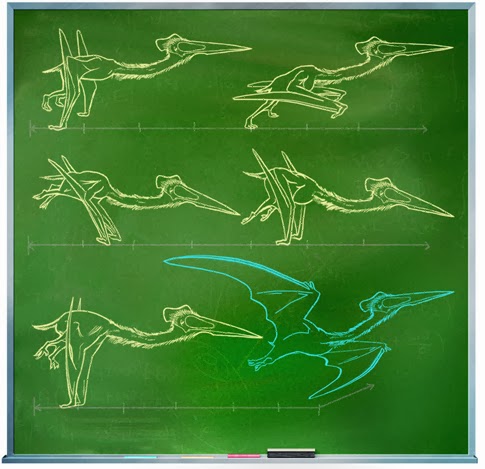
Illustration of the pterosaur quadrupedal launch. Appeared in Popular Science, credited to Kevin Hand (3 March 2009). 

Rossella Lorenzi
Discovery News

Pterosaurs, the flying lizards of the dinosaur age, ruled prehistoric skies with aerodynamic tricks like those found in modern aircraft, according to a fossil study. 

Pterosaurs appear in the fossil record at the end of the Triassic period, 220 million years ago and were the first vertebrates to achieve true flapping flight.

Like their dinosaur cousins, the creatures were affected by the mass extinction at the end of the Cretaceous period 65 million years ago, leaving no descendants.

Pterosaurs had light, hollow bones, but had wingspans up to 9 metres and more.

Indeed, fossilised bones recently found in Mexico suggest these creatures could have had a wingspan of at least 18 metres, the size of a plane.

Scientists have long wondered how these prehistoric jumbo jets could fly.

Now Dr Matthew Wilkinson of the University of Cambridge and colleagues report in the current issue of the journal Proceedings of the Royal Society B: Biological Sciences that these flying reptiles could take off and make soft landings thanks to the animal's pteroid bone.

The pteroid bone's connected to the ...
The pteroid was a long, slender bone unique to pterosaurs, was bent at the wrist and supported a membranous forewing that acted as a large flap at the front of each wing.

Scientists have debated the function of this bone, particularly its position in the wing.

Fossil studies suggest that it pointed toward the body, and that the forewing was relatively narrow.

Other studies suggest it was directed forward during flight, resulting in a much broader forewing.

"It is not possible to resolve the debate about pteroid function using fossil evidence alone," the researchers write.

They tackled the problem a different way. Using wind tunnel tests of scale models of pterosaurs, the researchers compared the performances of each position of the pteroid bone.

"We discovered that lift is greatly increased if the pteroid bone pointed forwards in flight, not inwards as had been previously believed. This had the effect of expanding the skin-like forewing in front of the arm," says Wilkinson.

Just like plane flaps
The high lift would have been vital in allowing the largest pterosaurs to take off and land, in a similar way that flaps work on aircraft wings.

Large pterosaurs would have been able to take off simply by spreading their wings while facing a breeze. The leading edge flap would also have slowed landings, acting as an airbrake.

"It would have also served as a control surface during normal flights. For example, flexing one pteroid while extending the other would have increased lift on one wing, thereby initiating a roll," the researchers write.

According to UK dinosaur expert Darren Naish of the University of Portsmouth, the study "provides a new rigorous interpretation of pterosaur aerodynamics".

"This work solves several mysteries that have long existed, and shows that pterosaurs evolved novel solutions to the problems of active flight."

Dino model shows the glide path to flight


Microraptor was a two-footed dinosaur - theropod - and the first to have feathers on its arms, legs and tail (Source: Jason Brougham/University of Texas, Austin)

ABC/AFP

Scientists using a wind tunnel and a full-scale model have shed light on how feathery dinosaurs adapted to the skies, a new study reports.

A widening consensus among palaeontologists is that birds evolved from small, feathery dinos. But the question is how?

Researchers at the University of Southampton created an anatomically correct model of a five-winged dinosaur deemed to be a precursor of birds.

"Normally people build models without the feathers, but we've tried to include the feathers because they bend with the wind and so we've got a combination of effects going on there," says study co-author Colin Palmer.

Microraptor was a two-footed dinosaur - theropod - and the first to have feathers on its arms, legs and tail, providing it potentially with five surfaces with which to gain "lift" against the air.

"It was a small animal that was discovered 15 years ago in the north east of China, and supposed to have been one of the first to have flown. So understanding how it flew is really important to know how flight began 150 million years ago," says Jacques Van der Kindere who was also involved in the study.

Experiments in a wind tunnel, supported by flight simulations, showed that even though these wings were rudimentary compared to those of modern birds, it could still carry out slow glides from low heights.

"Using a wind tunnel allows us to measure lift - the amount of force it could produce vertically to keep it in the air - the drag - the resistance to motion, and those two together gives us an idea of the speed that the animal could fly at. It also gives us the ability to look at the stability," says Palmer.
From a height of about 30 metres, it could glide between 70 and 100 metres - a useful means of grabbing a prey or fleeing a predator.

Judged by this, microraptor probably climbed a bit, foraged for food on the ground and glided only on occasion, say the authors.

"Microraptor did not require a sophisticated 'modern' wing morphology to undertake effective glides," write the authors of the paper published in the journal Nature Communications.

"Symmetric feathers first evolved in dinosaurs for non-aerodynamic functions, later being adapted to form lifting surfaces."

A leading hypothesis in the origin of birds is that, after learning to glide, feathered dinosaurs underwent evolutionary pressures that led to a more sophisticated wing, able to flap efficiently and adapt its shape to winds.
 

Smaug Breathes Fire Like A Bloated Bombardier Beetle With Flinted Teeth

Sunday, January 5, 2014


January 2, 2014

What does a narcissistic flying reptile that loves the taste of crispy dwarves have in common with a beetle that shoots hot, caustic liquid from its butt? More than you think.

A few weeks ago, audiences were finally treated to the Cumberbatch-infused reptilian villain from J.R.R. Tolkien’s classic The Hobbit. Smaug (pronounced and interpreted as if you smashed together “smug” and “smog”) is a terrible dragon that long ago forced a population of dwarves from under a mountain. He laid claim to all their treasures. He burned all their homes. The titular character of the book is then tasked with helping a company of these displaced dwarves take back the mountain from the beast. It wouldn’t be easy—the most common descriptor of a dragon is “fire-breathing,” after all. But unlike other aspects of the book and now the film that are wholly magic, Smaug’s burning breath is actually one of the least magical, and can be wrangled into plausibility. Doing so involves looking inside a beetle’s butt, a Boy Scout’s satchel, and a bird’s throat.

Even though they don’t exist, dragons, like all other real organisms, have evolved over time. They weren’t always so huge. Dragons were once the size of cattle in popular depictions. And some of them didn’t have wings, or breathe fire. Today’s dragons are uniquely terrible lizards—massive, spiked, voracious, flame-spewing beasts. If even mythical beasts evolve, how would a real dragon evolve its most recognizable ability?

First, a dragon needs fuel.

This aspect of dragon fire is the easiest to imagine. In fact, you are probably producing dragon fuel as you read this sentence. Methane—a highly flammable gas that is produced naturally by bacteria in the gut—is constantly bubbling up in your stomach as microbes munch on your food. With a large stomach or even a separate organ to house this gas, a dragon could easily eat enough food to produce a large amount of methane.

If methane isn’t the fuel, another more exotic liquid might be. Take the bombardier beetle. This incredible insect evolved (yes, evolved) a way to harness the chaos of chemical reactions in a defense mechanism. When under threat, the beetle excretes two chemicals from two separate reservoirs that mix in a third, producing a very hot liquid and the gas needed to propel it into the face of some would-be predator.

When two liquids come together, react, and spontaneously combust, they are called “hypergolic.” The bombardier beetle isn’t the only organism that takes advantage of hypergolic chemicals; we use them in rocket fuel. (You can see a nice small-scale demonstration of a hypergolic reaction here.) A dragon could do the same. It wouldn’t be the first fiction animal to do so either. Who can forget (or maybe remember?) the giant, fire-spewing “tanker” bug from the ironically classic sci-fi movie Starship Troopers?

If a dragon convergently evolved chemicals that combust upon mixing, like the explosive bombardier beetle, the reaction it harnessed could result in fire…terrible, terrible, fire. But these chemicals aren’t cheap, biologically speaking. A dragon would have to make a large biological investment to produce them. That would at least be consistent with dragons’ voracious appetite for dwarves, men, and livestock—the winged beasts need to produce more rocket fuel.

The next step in fire breathing is the spark.

Before you see a dragon’s flame you see the teeth. Terrifying spears and stake knives that click and clamor inside gigantic mouths—giant flints. Some dragon lore speculates that dragons, like modern birds, ingested rocks and stones to aid in digestion. Over time, stories say, the minerals would coat dragon teeth. Or maybe the dragons could hold some minerals in their mouths. Either way, quickly biting down on these minerals could produce a spark. Like a Boy Scout’s trusty flint, clicking dragon teeth would provide the ignition for either a glut of methane gas or a gush of hypergolic liquids (if needed).

Another possible spark could come from more detailed physics. If dragon teeth had piezoelectric properties—where mechanical stress produces small jolts of electricity—a combination of methane exhalation and teeth grinding could light the fire. Or maybe the crushed stones and minerals could vaporize in the air ahead of the methane and combust, as metals do on helicopter rotors in the Kopp-Etchells Effect. Perhaps the dragons could expel the liquids or gases so quickly from their bellies that static ignition would occur. (When cleaning out supertankers, for example, all the flammable vapors first must be vented. The high-pressure water jets used in cleaning can generate sparks that ignite the gas.) Could a dragon evolve an organ that produces its own spark like a kaiju from Pacific Rim? Science has many sources of ignition to choose from, it’s just a matter of what the fiction allows.

Dragons are basically our pipe-dreams of what birds would be if they still looked liked ancient dinosaurs but followed evolution’s flight plan. Dragons’ similarities with birds (themselves in fact dinosaurs) could provide the last critical link to flame flinging. With multiple stomachs aiding digestion, birds—and by extension, dragons—could evolve a specialized sack for storing either methane or combustible chemicals. Birds also eat stones and rocks to break up tough material in these stomachs, so Smaug munching on minerals isn’t that far-fetched either.

There are still a few problems. Dragons are huge, undoubtedly heavy creatures that would likely rip their own wings to shreds when attempting to stay airborne. Also, holding both a large amount of methane or hypergolic chemical internally is explosively problematic. Breathing out fire is a problem in and of itself. A dragon would need specialized tissues in the mouth to deal with the incredible heat, and lungs large enough to force the flames a significant distance (unless it was a dragon from Skyrim, which specializes in powerful blasts of voice). I imagine that a more scientifically plausible dragon wouldn’t be the slender, monitor lizard-like monstrosity we see in the latest Hobbit film and more like a flightless, bloated flame-thrower.

What does this mean for The Hobbit, a universe already filled with magic? Nothing at all. The film has its own problems to deal with. Nonetheless, I found Smaug’s fire breath to be one of the least distressing suspensions of reality. Whether a “true” fire-breathing dragon is filled with flint, gas, or rocket fuel, one thing is for sure: Where there is Smaug, there is fire.

About the Author: Kyle Hill is a freelance science writer and communicator who specializes in finding the secret science in your favorite fandom. Follow on Twitter @Sci_Phile